Roschon
Johnson.
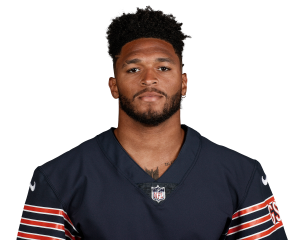
Roschon
Johnson.
 Texas· 6'0"· 219 lb· 4.58s 40
"A four-star quarterback who volunteered for the backfield and never asked for the job back — Johnson's value was always the stuff that does not show up in a carry count: protection, hands, and four phases of coverage teams."Pre-draft read
A 6-2, 219-pound one-cut runner who spent four years as the complementary back in a loaded Texas rotation, behind Keaontay Ingram and then Bijan Robinson. He presses the front side of inside zone, plants once, and gets north with a low pad level and active feet. Contact balance is the calling card: he breaks arm tackles at the second level and finishes falling forward.
The secondary trait is passing-down value. He is a natural hands catcher and a willing protector who identifies pressure, squares his frame, and strikes the blitzer instead of absorbing him. Long speed is functional, not dangerous. The signature is selflessness: a four-star quarterback recruit who moved to running back in camp week and became the roster's best core special-teamer.
Gap and inside-zone run game that asks him to press downhill between the tackles rather than stretch the play to the sideline.
Year 1: third-down and short-yardage back plus four-phase special teamer. Ceiling: 1B in a committee handling 8-10 physical touches a game.
A wide-zone offense that lives on perimeter stretch runs and asks the back to threaten the edge and cut back at full speed.
His floor is a roster spot earned on teams; his offensive role rises or falls with how much short-yardage work the staff hands out.
Roschon Johnson Highlights: Texas Tech vs. Texas (2019)
Freshman-year workload game showing the downhill pad level and contact balance that defined his Texas tape.
Roschon Johnson — Texas RB Highlights
Career reel of short-yardage conversions, checkdown receptions and blitz pickups from the Texas rotation.
Texas QB/RB Roschon Johnson Highlights
Includes his quarterback background before the position switch, useful context on his athleticism and toughness.
Johnson arrived in Austin as a four-star quarterback out of Port Neches-Groves and switched positions during his first fall camp because Texas needed a body in the backfield. He never switched back. Four seasons later he left as a 47-game contributor who never touched 130 carries in a year and was still one of the most respected players in the building — team captain, core special-teamer, the culture guy.
The production tells a specific story. He rushed 392 times for 2,190 yards and 23 touchdowns with 56 catches for 420 yards, averaging better than 5.2 yards a carry in each of his last three seasons behind a rebuilding offensive line and against defenses that knew Texas wanted to run. That efficiency in a backup role, on short-yardage and closeout carries, was the evaluation. The flags were the counting stats and the athletic profile: a 4.58 forty, a 31.5-inch vertical, and a game that lives between the tackles.
Boards had him in the fourth-to-fifth-round band as a big-bodied complement rather than a lead back, and several rooms graded his special-teams tape higher than his offensive tape. Chicago took him at 115 as the physical counterweight to D'Andre Swift, betting a back who already blocks, catches and covers kicks would be useful in Week 1 regardless of the carry split.
- 01
Contact balance
He absorbs shots from linebackers and safeties without losing his base, routinely converting a stopped run into three extra yards.
- 02
Pass protection
Rare college-back willingness and technique in the blitz pickup: he sees the pressure, squares his shoulders, and strikes rather than catches.
- 03
Hands out of the backfield
Natural catcher on checkdowns and swing routes, with 56 career receptions and no drop reel worth flagging.
- 04
Short-yardage reliability
Texas trusted him on third-and-two and at the goal line, and he converted with pad level and leg drive instead of guesswork.
- 05
Special-teams value
A four-phase core player and captain whose coverage tape alone would earn him a roster spot on most NFL teams.
- 01
Long speed
The 4.58 forty shows up on film: he does not pull away from second-level angles and rarely turns a crease into an explosive.
- 02
Lateral agility
Tight in the hips when asked to bounce a run outside, which limits him in wide-zone concepts that need a hard edge cut.
- 03
Vision on stretch runs
He can be quick to commit to the first crease instead of pressing the aiming point and letting the backside cut open up.
- 04
Career workload
He never carried more than 123 times in a season, so there is no evidence he can hold up as a true feature back.
— — — positional median (p50)
- 40 yd
- 4.58sp50
- Vertical
- 31.5inp50
- Broad jump
- 122inp50
- Three-cone
- —s
- Shuttle
- —s
- Bench
- —rep
| Yr | Team | G | Att | Yds | TD | Rec | RecYds |
|---|---|---|---|---|---|---|---|
| 2019 | Texas | 13 | 123 | 649 | 7 | 23 | 158 |
| 2020 | Texas | 10 | 80 | 418 | 6 | 8 | 51 |
| 2021 | Texas | 12 | 96 | 569 | 5 | 11 | 83 |
| 2022 | Texas | 12 | 93 | 554 | 5 | 14 | 128 |
| Career | — | 47 | 392 | 2190 | 23 | 56 | 420 |
Season totals verified on cfbstats (2020-22) and Sports-Reference (2019, bowl games included); the four seasons sum exactly to the career line. Receiving touchdowns (3 career) and his single 2021 pass attempt (1-of-1, 2 yards) are omitted from the table shape.
A dash means the figure is not published by a source we trust — never a zero we invented.
A physical RB3 whose real value is coverage-unit snaps, with occasional short-yardage work when the top two backs need a breather.
Same trusted-in-every-phase profile: goal-line carries, third-down protection, and a coaching staff that keeps finding uses for him.
Backfield depth who bounces between the 53 and the practice squad because he does not add speed to the room.
Everything above is the pre-draft evaluation. This section is what actually happened — updated year over year.
Chicago got exactly the player it drafted. Johnson led all Bears rookies in carries, rushing yards, catches, receiving yards and scrimmage yards in 2023, finishing with 81 carries for 352 yards and two touchdowns plus 34 receptions for 209 yards in 15 games behind Khalil Herbert and D'Andre Swift. Year two narrowed him into a short-yardage specialist: 55 carries for 150 yards but a career-high six touchdowns, most from inside the five, with 16 catches added on. Year three closed the offensive door. He appeared in seven games, played four offensive snaps against 102 on special teams, took two handoffs for 17 yards, and a November thumb injury ended his season. He entered 2026 competing for RB3 behind Swift and Kyle Monangai.
In hindsight the grade was right and the projection was right; only the ceiling was overwritten by roster math. Johnson was never going to be a lead back, and Chicago never asked him to be one — but each new staff valued him a notch lower on offense than the last, and a back who does not create explosives has a short runway once a room adds speed. He remains the version of a fourth-round running back teams should want: a durable body who blocks, catches, covers kicks and never costs you a game. Just not one who wins you many either.