Noah
Sewell.
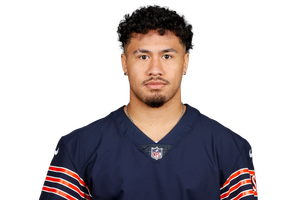
Noah
Sewell.
 Oregon· 6'2"· 246 lb· 4.64s 40
"Sewell was never a coverage projection; he was a 246-pound collision at the second level, and Chicago paid fifth-round money for the thump and the special teams floor that came with it."Pre-draft read
Downhill thumper who lived at the second level of Oregon's front, aligned as the stack MIKE with freedom to trigger on his read. Built like a small defensive lineman at 246 pounds, he attacked the instant his key declared, met pulling guards in the hole rather than absorbing them, and finished with real pop.
The secondary trait was short-area burst: a 1.57-second ten-yard split and 27 bench reps confirmed the play strength the tape suggested. Against the run he was a legitimate stack-and-shed presence who deconstructed blocks with heavy hands. In coverage the picture narrowed, with tight hips and late click-and-close in space. The signature was collision — few 2023 linebackers hit with more force.
Attacking one-gap front that lets him play downhill as the stack MIKE with a two-high shell behind him and minimal man coverage responsibility.
Year 1: core four-phase special teams with early-down run-defense snaps. Ceiling: two-down starting MIKE who comes off the field on third down.
Light-box nickel defense that asks its linebackers to match tight ends and backs man-to-man for 40 snaps a game.
His value rises in proportion to how many first- and second-down snaps the defense actually plays in base personnel.
Noah Sewell 2022 Highlights | Oregon LB | 2023 NFL Draft Prospect
Final college season: downhill run fits, block deconstruction and short-yardage stops.
Noah Sewell 2021 Highlights | Oregon LB
The 114-tackle sophomore year that built his draft case, including TFL and blitz reps.
Noah Sewell Film Breakdown | Oregon LB
All-22 breakdown of his run triggers, stack-and-shed technique and coverage limitations.
Sewell entered Oregon as a five-star and started collecting production immediately, and by his second season he was the identity of the Ducks defense: a thick, violent stack linebacker who processed run keys quickly and struck with real intent. Everything about the profile was built around downhill football — press the line of scrimmage, take on the block, make the tackle in the backfield.
The 2021 tape was the argument: 114 tackles in 14 games with 8.5 tackles for loss, 4.0 sacks, an interception and five passes broken up, all on a defense that faced Ohio State and Utah twice. The 2022 season complicated it. His snap count and role shrank under a new staff, tackles dropped to 56, and the coverage exposure that had always been the question showed up more often on third down. The Combine answered the strength and burst questions but not the change-of-direction ones.
Boards had him in the third-to-fourth round band on name and 2021 production, with a soft floor into Day 3 for teams that graded him a two-down thumper. Chicago took him at 148 as a special teams contributor with early-down defensive upside behind an established linebacker room.
- 01
Downhill trigger
Reads run keys fast and gets to the line of scrimmage before blockers can climb, which is where every good rep of his college tape starts.
- 02
Play strength
Genuine 246-pound power that shows up meeting pullers in the hole; 27 bench reps at the Combine matched what the block-destruction reps already suggested.
- 03
Tackling force
Finishes through contact rather than at it, and the collision consistently knocks the ball carrier backward instead of allowing a fall-forward gain.
- 04
Stack-and-shed
Takes on offensive linemen square, keeps his frame clean with heavy hands and can disengage in the gap to make the tackle himself.
- 05
Blitz value
Timed interior pressure was a real part of his 2021 profile, with 4.0 sacks and a short-area burst that arrives before the guard can reset.
- 01
Coverage range
Tight hips and a slow flip make him vulnerable carrying tight ends vertically or expanding to the flat against the modern passing game.
- 02
Click-and-close
Late to drive on throws in front of him in zone, which turns short completions into catch-and-run yardage in the middle of the field.
- 03
2022 regression
Production and snap share both fell under a new staff, and the tape that year lacked the disruption density of his sophomore season.
- 04
Play-speed ceiling
The 4.64 forty is fine for the box but caps his ability to chase plays sideline to sideline once the ball gets outside the tackle.
— — — positional median (p50)
- 40 yd
- 4.64sp50
- Vertical
- 33inp50
- Broad jump
- 115inp50
- Three-cone
- —s
- Shuttle
- —s
- Bench
- 27repp50
| Yr | Team | G | Tkl | Sk | Int | PD | FF |
|---|---|---|---|---|---|---|---|
| 2020 | Oregon | 7 | 45 | 2 | 0 | 0 | 1 |
| 2021 | Oregon | 14 | 114 | 4 | 1 | 5 | 2 |
| 2022 | Oregon | 12 | 56 | 1.5 | 1 | 4 | 0 |
| Career | — | 33 | 215 | 7.5 | 2 | 9 | 3 |
Season totals sum exactly to career totals (45+114+56=215 tackles; 6.5+8.5+5.5=20.5 TFL; 2.0+4.0+1.5=7.5 sacks). Tankathon lists 49 combined tackles in 2020 and 21.0 career TFL; cfbstats is the canonical source here. Fumble recoveries not itemized by cfbstats for 2020-2021, so those splits are left null rather than zero-filled.
A dash means the figure is not published by a source we trust — never a zero we invented.
Core special teams contributor who spot-starts and holds up against the run without ever winning a coverage role.
Downhill run-defense identity that eventually earned every-down trust once the processing caught up with the physicality.
Depth thumper whose roster life depends entirely on kick-coverage value rather than defensive snaps.
Everything above is the pre-draft evaluation. This section is what actually happened — updated year over year.
Chicago used him exactly as the pick implied. He played 13 games as a rookie in 2023 without a defensive start, logging nine tackles and a forced fumble while making his living on kick and punt units. The 2024 season was smaller still — nine games, four tackles — as the defensive linebacker rotation stayed closed in front of him and his value stayed on teams. Then 2025 changed the shape of his career: injuries opened the room, he started nine of 13 games, and he produced 59 combined tackles and another forced fumble as a legitimate rotational starter. The run ended in late December with a torn Achilles that sent him to injured reserve, and he opened 2026 training camp on the active/PUP list still working back.
In hindsight the evaluation aged accurately rather than cheaply. Nobody drafting him at 148 expected coverage growth, and he did not deliver it; what he did deliver was three years of reliable special teams work and, when finally given real defensive snaps, exactly the downhill run defense the tape promised. The fifth round was the right price for a two-down thumper. The Achilles injury is what makes the story unfinished — he had just proved he could hold a starting-caliber role when the leverage got taken away.