
Michael
Wilson.
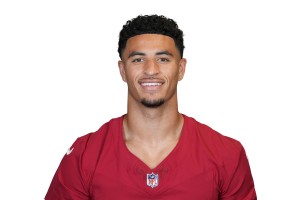
Michael
Wilson.
 Stanford· 6'2"· 213 lb· 4.58s 40
"The tape said early Day 2 and the medical file said wait; Arizona split the difference at 94 and got a boundary starter whose only real flaw at Stanford was a body that kept sending him inside."Pre-draft read
Wilson is a big-bodied X receiver who plays the position like a technician rather than a burner. Stanford asked him to beat press on the outside, and he does it with a clean release package, patient stem work and hands that snatch away from his frame. He tracks the deep ball naturally and adjusts late, which is why so much of his tape is sideline and back-shoulder wins.
The secondary trait is the dirty work: he blocks in the run game with intent and plays through contact after the catch. Athletically he is good rather than rare — 4.58 with a 37.5-inch vertical — but the explosion shows up on jump balls and in the red zone. The signature is reliability in tight windows.
Timing-based play-action offense with a defined X spot, where the boundary receiver is asked to beat press, work back-shoulder and win on the perimeter in condensed splits.
Year 1: starting X who handles press and third-down conversions while the offense builds around a burner. Ceiling: high-volume No. 2 who clears 1,000 yards on efficiency rather than manufactured touches.
A pure vertical spread that asks its outside receivers to run go routes off clean releases and win with pure speed — his value is in the release and the catch point, not in outrunning safety help.
Best next to a true field-stretcher who forces single-high looks and leaves him one-on-one on the boundary.
Michael Wilson Ultimate Stanford Highlights
Stanford tape showing the release package, deep-ball tracking and contested catches.
Michael Wilson Senior Bowl Highlights and Interview
Senior Bowl one-on-one reps that lifted his stock in the 2023 cycle.
Michael Wilson 2025 Highlights
His 1,000-yard 2025 season in Arizona as the No. 2 opposite Marvin Harrison Jr.
Wilson arrived in the 2023 cycle as one of the cleanest evaluations in the receiver class and one of the riskiest files. On tape he was a polished outside target with an NFL release package, natural tracking and the frame to play through contact, and he backed it up as a late Senior Bowl add who stood out in one-on-ones.
The production never matched the ability because his body would not cooperate. After a full 13-game freshman year and a breakout sophomore season that led Stanford with 56 catches for 672 yards, he played only 14 games across his final three seasons: a foot injury ended his 2020 after four games, the carryover cost him the start of 2021, and a season-ending injury at Notre Dame in October shut down his 2022 after six games. When available he was excellent, capping the last of those runs with a 176-yard game and Pac-12 honorable mention as a team captain.
The board split accordingly. Traits and polish said early Day 2; the medical file said wait. Some outlets had a fourth-round grade on him. Arizona taking him at 94 was a bet that the injuries were bad luck rather than a body that could not hold up, and that a receiver-poor roster could afford the risk.
- 01
Release package
Wins against press with quick hands and a varied stem, getting into routes cleanly rather than relying on a runway to build speed.
- 02
Contested-catch hands
Snatches the ball away from his frame and finishes through contact on sideline and back-shoulder throws, with a big catch radius at 6-foot-2, 213.
- 03
Deep-ball tracking
Locates the football over either shoulder and adjusts late without breaking stride, turning average separation into completions down the field.
- 04
Explosive traits in tight space
A 37.5-inch vertical and 10-foot-5 broad jump show up on jump balls and red-zone fades where he simply plays above the coverage.
- 05
Run-game willingness
Blocks on the perimeter with genuine intent and finish, a Stanford habit that gets a young receiver on the field in base personnel.
- 01
Extensive medical file
Played only 14 games across his final three college seasons, with a 2020 foot injury and a 2022 season-ending injury bookending the run.
- 02
Long speed
A 4.58 forty is functional rather than scary, and he does not consistently take the top off a defense against NFL corners with recovery speed.
- 03
Thin production sample
134 career catches over five years left evaluators projecting from flashes instead of a sustained volume season after 2019.
- 04
Separation versus quickness
Can be shadowed by twitchier defensive backs on option and quick-game routes where his win comes from body position, not burst.
— — — positional median (p50)
- 40 yd
- 4.58sp50
- Vertical
- 37.5inp50
- Broad jump
- 125inp50
- Three-cone
- —s
- Shuttle
- 4.27sp50
- Bench
- 23repp50
| Yr | Team | G | Rec | Yds | TD |
|---|---|---|---|---|---|
| 2018 | Stanford | 13 | 14 | 126 | 1 |
| 2019 | Stanford | 12 | 56 | 672 | 5 |
| 2020 | Stanford | 4 | 19 | 261 | 1 |
| 2021 | Stanford | 4 | 19 | 185 | 0 |
| 2022 | Stanford | 6 | 26 | 418 | 4 |
| Career | — | 39 | 134 | 1662 | 11 |
Receiving totals verified against cfbstats.com game logs (2020-2022) and Stanford official season bios (2018-2019); season sums match the 39-game, 134-catch, 1,662-yard career line. Rushing recorded only in 2018 and 2022.
A dash means the figure is not published by a source we trust — never a zero we invented.
A big-bodied outside starter who blocks, wins at the catch point and lives as a reliable No. 2.
The high-volume possession X who converts contested targets into a 1,000-yard floor without elite speed.
A rotational outside receiver whose availability and target share never stabilize past 500 yards a season.
Everything above is the pre-draft evaluation. This section is what actually happened — updated year over year.
Michael Wilson played in 13 games for the Arizona Cardinals in his rookie season (2023), starting 12 and recording 38 receptions for 565 yards and 3 touchdowns.
Arizona got the healthy version almost immediately. He played 13 games as a rookie in 2023 with 38 catches for 565 yards and three touchdowns, already trusted as a starter on the outside. In 2024 the arrival of Marvin Harrison Jr. pushed him into a complementary role and his line held steady at 47 receptions for 548 yards and four scores across 16 games. The breakout came in 2025: all 17 games, 78 catches on 126 targets, 1,006 yards and seven touchdowns, the first 1,000-yard season of his career and a top-30 PFF receiving grade, all as the No. 2 next to Harrison.
In hindsight this is the pick that vindicates buying tape over availability. The medical risk was real and priced in, and it simply never showed up: he has missed only a handful of games in three professional seasons while the traits scouts liked at Stanford translated exactly as advertised. Arizona entered 2026 with him in the final year of his rookie deal and extension talks open, which is the market's way of admitting a third-round receiver became a legitimate starter.
Data note: from Philadelphia