Jake
Andrews.
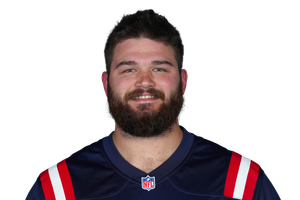
Jake
Andrews.
 Troy· 6'3"· 305 lb· 5.15s 40
"A Sun Belt center whose anchor and line-call command were always more relevant to the actual job than the forty time that boards kept flinching at, which is why the fourth round undersold him."Pre-draft read
Andrews is a compact, wide-based interior lineman who split his Troy career between guard and center, and the tape is a leverage study: low pad level out of his stance, hands inside the framework, and a short, violent punch that jolts a nose tackle onto his heels. He is best in a phone booth on down blocks and duo, where his hips stay under him and he churns feet to finish.
The secondary trait is functional coordination on the move — he can pull short, reach a three-technique on front-side zone, and climb to the second level even without much closing juice. The projection tightens in pass protection: he anchors in place rather than redirecting, and recovers hands-first instead of feet-first. The signature is snap-to-punch timing at center.
Gap and duo-heavy run scheme with vertical-set, quick-game protections that keep the pivot in a phone booth.
Year 1: backup center and interior swing piece on jumbo packages. Ceiling: multi-year starting NFL center in a power-based front.
A wide-zone offense asking the center to reach nose tackles on the front side and climb to second-level linebackers in space every snap — his lateral range and closing speed make those blocks a coin flip.
His value is concentrated at center, where communication and anchor matter more than range; at guard the athletic limitations get exposed against interior loopers.
Jake Andrews College Highlights, Troy University, C | New England Patriots 2023 NFL Draft Pick
Team-produced college reel of his center play at Troy.
Former Troy Trojans Center Jake Andrews Looking Forward To The Challenge of the Senior Bowl
Senior Bowl context on his pre-draft evaluation.
Jake Andrews combine presser clip
Combine media session ahead of the 2023 draft.
Jake Andrews arrived at Troy in 2018 as a developmental body who played three games as an extra blocker, redshirted, and then became the offense's constant. He rotated through interior spots as a redshirt freshman in 2019, settled in as the right guard for the 2020 and 2021 seasons, and moved to center for 2022 — the season that made him a draftable player rather than a productive Sun Belt lineman.
That 2022 year is the whole evaluation. Playing pivot for a Troy team that won the Sun Belt championship, he handled line calls against fronts that moved late, held up on the nose, and earned all-conference recognition doing it. The flags were the ones you would expect from that profile: he tested as a below-average NFL athlete at the combine (5.15 in the forty, 26-inch vertical at 305 pounds), his arms measured under 33 inches, and the level of competition meant he rarely saw the kind of interior power and counter quickness a Sunday front generates.
Boards had him as a Day 3 developmental center, with public mocks bunched in the fifth-to-seventh-round range before he climbed. New England took him at 107 because the fit was obvious for a staff that valued interior versatility and communication over athletic ceiling — a backup center now, a bet on the position flexibility later.
- 01
Snap-to-punch timing
He fires the ball and gets his hands inside almost simultaneously at center, which is the hardest thing to teach at the position and the trait that carried his 2022 tape.
- 02
Anchor strength
Wide base and low center of gravity let him absorb bull rushers without getting walked into the quarterback's lap on straight-ahead power.
- 03
Positional versatility
Twenty-three starts at right guard and fourteen at center in the same career, which is exactly the flexible bench profile an NFL roster budgets for.
- 04
Down-block finisher
On duo and gap concepts he churns feet through contact and buries defenders rather than settling for a stalemate.
- 05
Line-call intelligence
Ran the protection calls for a conference-championship offense as a first-year center and rarely lost the count against late movement.
- 01
Athletic ceiling
A 5.15 forty and 26-inch vertical at 305 pounds put him in the bottom tier of tested interior linemen in the class, and it shows in space.
- 02
Lateral redirect
Slide protection against quick interior counters gets him leaning, and he catches more than he strikes when the rusher moves first.
- 03
Arm length
Under 33 inches means defenders reach his chest before he reaches theirs, so he lives on perfect timing rather than margin.
- 04
Level of competition
Sun Belt interior fronts rarely tested him with the size-plus-quickness combination he will see weekly in the NFL.
— — — positional median (p50)
- 40 yd
- 5.15sp50
- Vertical
- 26inp50
- Broad jump
- 102inp50
- Three-cone
- —s
- Shuttle
- 4.73sp50
- Bench
- —rep
| Yr | Team | G |
|---|---|---|
| 2018 | Troy | 3 |
| 2019 | Troy | 12 |
| 2020 | Troy | 11 |
| 2021 | Troy | 12 |
| 2022 | Troy | 14 |
| Career | — | 52 |
Offensive linemen do not accumulate box-score statistics. Games and starts come from Troy season-by-season reporting; unpublished start counts are left null rather than zero-filled.
A dash means the figure is not published by a source we trust — never a zero we invented.
The most honest landing spot — a tough, versatile interior lineman who bounces between guard and center, starts for years, and is a solid rather than special piece.
The realistic ceiling if the anchor and line-call command translate fully: a durable, decade-long starting center who wins with leverage and intelligence rather than movement skills.
The floor if the length and athletic limitations combine with injury: a career backup center who never sticks as a full-time starter.
Everything above is the pre-draft evaluation. This section is what actually happened — updated year over year.
New England took him in the fourth round as a center-guard swing piece and used him accordingly: sixteen games as a rookie in 2023 with one start, mostly on field goal and jumbo packages while he learned two positions. The 2024 season never happened — he opened camp on the physically unable to perform list and was placed on season-ending injured reserve on August 5, wiping out the year that was supposed to be his push for a starting job. New England released him on April 28, 2025, in a routine roster clear, and Houston claimed him off waivers the next day.
That claim is the story. In Houston he won the center job outright and started all sixteen regular-season games plus two playoff games in 2025, logging just under 1,100 snaps and grading out as a solid-if-unspectacular middle-of-the-pack starter. He remains on the Texans roster into 2026. The honest retrospective is that the athletic testing flagged a real ceiling and the pass-protection concerns were legitimate — he is not a plus starter in space — but the traits that actually mattered for a center, anchor and communication, were undervalued because they came wrapped in a Sun Belt résumé and a bad forty time. A fourth-round pick who became a full-time NFL starting center is a win, just not for the team that drafted him.