Deuce
Vaughn.
Deuce
Vaughn.
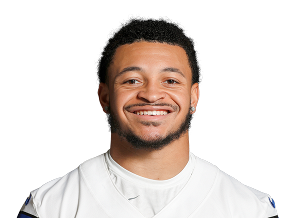
 Kansas St.· 5'5"· 179 lb
"The smallest player ever to walk into the Combine was also one of the most productive backs in the country, and the whole evaluation came down to whether NFL spacing would still let him disappear behind blockers."Pre-draft read
Vaughn was Kansas State's entire backfield identity: a 5-5, 179-pound weapon who took the early-down carries out of gun zone and stretch looks, then stayed on the field as a detached slot receiver on third down. His trait is leverage — he runs under the tackler's hands, presses the frontside, and cuts off one flat step without gathering, so pursuit angles arrive a half-body late.
The second skill is real hands, not check-down hands: he tracks the ball away from his frame, wins on option routes from the slot, and turns swing passes into perimeter runs. He is quick rather than fast — 35.5-inch vertical, no timed 40 in Indianapolis — and his signature is contact balance no back his size should own.
Wide-zone spread offense with a heavy 11-personnel passing menu
Year 1: 6-10 designed touches per game as a gadget and third-down receiving back with return value. Ceiling: a Darren Sproles-style matchup piece who leads a backfield in receptions without ever carrying the run game.
Under-center gap-scheme offense that asks its backs to run behind a pulling guard and stay in to protect against A-gap pressure — he would be off the field on every early down and every obvious pass.
Only works with a coordinator willing to script his snaps; as an undifferentiated RB3 taking whatever carries are left over, he has no path to the field.
Deuce Vaughn Full Career Highlights (2020-2022)
Three-season Kansas State reel showing the leverage running, cutback vision and slot receiving that defined his college production.
Deuce Vaughn Kansas State Career Highlights
Second full-career cut with more third-down and passing-game snaps out of detached alignments.
ROOK: Deuce Vaughn | Dallas Cowboys 2023
Team-produced rookie-season feature covering the draft-day call from his father and his first NFL camp.
Vaughn is the most productive small back the modern draft has evaluated, and the size is not a footnote — it is the evaluation. He measured as the smallest player ever to attend the Combine and still carried a Power Five offense for three years, which means every scout had to decide whether the tape was real or a function of scheme, spacing and Big 12 defenses that missed tackles in space.
The production says real. He gained 1,404 rushing yards as a sophomore and 1,558 as a junior on 293 carries, and he never stopped catching the ball — 116 receptions and 1,280 receiving yards across three seasons, numbers most college slot receivers do not reach. He was a two-time Consensus All-American, the second in Kansas State history. The flags are structural: he cannot pass protect against NFL linebackers, he is a liability on short yardage, and his junior workload already looked heavy for the frame.
The board treated him as a Day 3 change-of-pace and returner, a role player whose ceiling was a designed-touch package rather than a rotation. Dallas took him 212th, and the moment was made famous by the phone call from his father Chris, a Cowboys scout who recused himself from the evaluation. The value was fine at that price; the projection was always the problem.
- 01
Contact balance
Plays far heavier than his listed 179 pounds, absorbing hits from linebackers without losing his feet and finishing runs three and four yards past first contact.
- 02
Short-area burst
Reaches full speed inside two steps and changes direction without a gather step, which lets him win the cutback lane before defenders can redirect their hips.
- 03
Legitimate receiver
Caught 116 passes in three seasons, aligned detached in the slot, and tracked the ball naturally away from his body rather than cradling it.
- 04
Vision and patience
Presses the frontside of zone runs, waits for the second-level defender to commit, then attacks the crease decisively instead of dancing behind the line.
- 05
Proven volume producer
Handled 293 carries as a junior on a Big 12 title team and answered with 1,558 yards, so the durability questions were never about missed games.
- 01
Frame limits
At 5-5 and under 180 pounds he is the smallest player to attend an NFL Combine, and NFL tacklers can simply wrap and drop him where Big 12 defenders could not.
- 02
Pass protection
Cannot anchor against blitzing linebackers and is a mismatch waiting to be exploited, which caps his snaps on obvious passing downs in the NFL.
- 03
Short yardage and goal line
Has no answer inside the tackles when the box is stacked, so his usage narrows to spaced-out looks and designed touches.
- 04
Long speed
Declined to run the 40 in Indianapolis and does not pull away from angles on tape, meaning explosive runs die at the safety instead of ending in the end zone.
— — — positional median (p50)
- 40 yd
- —s
- Vertical
- 35.5inp50
- Broad jump
- 116inp50
- Three-cone
- —s
- Shuttle
- —s
- Bench
- —rep
| Yr | Team | G | Att | Yds | TD | Rec | RecYds |
|---|---|---|---|---|---|---|---|
| 2020 | Kansas State | 10 | 123 | 642 | 7 | 25 | 434 |
| 2021 | Kansas State | 13 | 235 | 1404 | 18 | 49 | 468 |
| 2022 | Kansas State | 14 | 293 | 1558 | 9 | 42 | 378 |
| Career | — | 37 | 651 | 3604 | 34 | 116 | 1280 |
Verified line by line on cfbstats.com (Kansas State team 327, player 1111622) for 2020, 2021 and 2022; season sums match the career totals exactly (37 games, 651 carries, 3,604 rushing yards, 34 rushing TDs, 116 receptions, 1,280 receiving yards, 9 receiving TDs). Kick returns appear only in 2020 (7 returns, 145 yards, 0 TD) and are omitted from this shape; no punt-return or passing data exists, so those fields are omitted rather than zero-filled.
A dash means the figure is not published by a source we trust — never a zero we invented.
Gadget-sized producer who bounced between backfield and slot without ever owning a real role, and lasted on rosters through returns.
The outcome the pick was chasing: a sub-5-8 back whose receiving volume and return work made him a genuine weekly weapon rather than a package.
Talented college back whose NFL usage never materialized, leaving him on practice squads and out of the league before a fourth season.
Everything above is the pre-draft evaluation. This section is what actually happened — updated year over year.
Dallas kept him on the roster as a rookie and gave him almost nothing: seven games, 23 carries for 40 yards, seven catches for 40 yards, no touchdowns and no return job. Year 2 was the same shape with slightly better efficiency — seven games, 17 carries for 70 yards — and once again the offense never built the designed-touch package that the entire projection depended on. He kept starring in August, which became its own trap; a preseason legend who cannot be trusted on third down has nowhere to live on a 53-man roster. Dallas waived him at final cuts in August 2025, Denver signed him to the practice squad that September without ever activating him, and the Broncos waived him in May 2026. He signed with the UFL's Orlando Storm at the end of that month and joined Houston on a depth deal in August 2026.
The honest read is that the flags won. Nothing about his college tape was fraudulent — the vision, hands and balance all showed up in preseason games — but NFL defenses never gave him the spacing Big 12 defenses did, and a back who cannot protect the quarterback or convert third-and-one only plays if a coordinator scripts touches for him. Nobody ever did. Pick 212 is the correct price for that bet and the team lost nothing by making it, which is the fairest thing you can say: the evaluation was right, the role never arrived.