Chandler
Zavala.
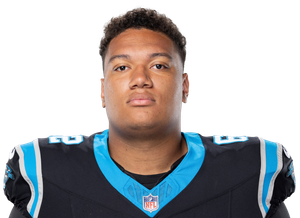
Chandler
Zavala.
 North Carolina St.· 6'3"· 322 lb
"A Division II power lifter who translated straight-ahead torque into First-Team All-ACC play in one healthy season — he wins by moving people, and he loses when he has to move himself."Pre-draft read
Zavala is a power-based interior guard who lined up almost exclusively at left guard for NC State. He is a mass-and-leverage player: he fires out low on down blocks, gets his hands into the chest plate and finishes with his feet still driving, and in a phone booth few interior defenders walk him backward. His best reps come on gap and duo concepts where he only has to move a man off a spot.
In protection he is a sit-and-anchor guard rather than a mirror artist. He absorbs bull rushes with a wide base and heavy hands, but he is late to redirect when a rusher works across his face, and he can be a beat slow reaching the second level in space. The athletic ceiling is average; the signature is raw torque at the point of attack.
Gap and duo-heavy run scheme that lets the guard drive block downhill instead of reaching or pulling
Year 1: starting or swing guard in a power run offense with help against interior twists. Ceiling: a multi-year starting guard on a team that runs behind him and keeps his pass sets simple.
An outside-zone-first offense that asks guards to reach playside shades and climb to the backer on the move — the lateral quickness is the exact trait that scheme taxes hardest.
Value rises in short-yardage and goal-line packages where the field shrinks and pure torque wins.
Chandler Zavala breaks down his own NC State tape
Zavala walking through his own guard reps at NC State, hand placement and finish.
#Pack21: OL Chandler Zavala
NC State feature on his arrival and role on the interior offensive line.
Chandler Zavala on his first game action
Rookie-year Panthers piece after his first NFL snaps at guard.
Zavala took an unusual road to the draft: a late start in football, three seasons at Division II Fairmont State, then a transfer to NC State to prove the power translated against ACC fronts. He is a thickly built 6-3, 320-plus-pound guard whose identity is displacement — he wants to block down, double, and finish, and he is at his best when the play design lets him fire straight ahead.
His NC State tenure was short but convincing. A season-ending injury cut his 2021 to five starts, and after a fight with the NCAA over eligibility he came back for a full 2022, started all 12 games and earned First-Team All-ACC honors. The tape backed the award: consistent, physical run blocking and a durable anchor in protection. The flags were the movement profile in space, the limited overall snap volume against top competition, and a medical file with two lost seasons on it.
Boards had him as a Day 3 interior starter candidate with a high floor and modest ceiling — a plug-and-play guard for a run-first offense rather than an athlete to develop. Carolina taking him at 114 was a straightforward roster call for a line that needed immediate interior toughness.
- 01
Point-of-attack power
Generates real displacement on down blocks and doubles; he can move a nose tackle off the spot and finish the rep on the ground.
- 02
Anchor
Sits into bull rushes with a wide base and heavy hands, rarely giving up the depth that collapses a pocket from the inside.
- 03
Hand strength
Once he latches on the chest plate the defender is stuck; his grip lets him ride blocks well past the initial contact point.
- 04
Proven jump in level
Went from Division II to First-Team All-ACC in his one healthy Power Five season, which is real evidence the strength travels.
- 05
Play temperament
Competitive, physical finisher who plays through the whistle and sets the tone in the run game.
- 01
Lateral quickness
Slow to redirect when rushers cross his face, which shows up against quick interior twist games and slanting fronts.
- 02
Work in space
Labors on pulls and climbs to the second level; he is not the guard you want leading a screen or hitting a moving linebacker.
- 03
Medical file
Two seasons lost to injury across his college career, including the 2021 surgery, put durability at the center of his evaluation.
- 04
Snap volume
Only 17 career games against Power Five competition, so the sample of him beating high-level interior rushers is thin.
| Yr | Team | G |
|---|---|---|
| 2021 | NC State | 5 |
| 2022 | NC State | 12 |
| Career | — | 17 |
Only his NC State seasons are listed: games and starts are verified (5+12 = 17 G / 17 GS, matching the career line). He also played at Division II Fairmont State from 2017 to 2019 (2020 season canceled), but per-season games and starts there are not published and are deliberately omitted rather than zero-filled. Offensive linemen do not carry countable statistical output.
A dash means the figure is not published by a source we trust — never a zero we invented.
A power-first guard who starts real games in the right scheme but bounces in and out of the lineup.
The outcome where the mass and anchor make him a long-term interior starter who never needs to be an athlete.
The version where the movement limits and injuries turn a fourth-round starter into a swing/practice-squad body.
Everything above is the pre-draft evaluation. This section is what actually happened — updated year over year.
Zavala won a starting guard job in Carolina almost immediately as a rookie, then his 2023 turned frightening: on October 8, 2023 at Detroit he went down in the first quarter, was strapped to a backboard and carted off with a neck injury, and was taken to a hospital for evaluation. He recovered and traveled home with the team, but the season was effectively over. He stayed on Carolina's roster in 2024 in a rotational and spot-starting role, and in 2025 he was back in the lineup as the starting right guard for stretches, finishing with seven games and five starts. His career line through 2025 sits at 34 games and 14 starts, all with the Panthers. In 2026 the numbers game caught up: Carolina waived him on August 31 to make room for a claimed guard, he cleared waivers, and the team brought him back on the practice squad a day later.
In hindsight the evaluation held up almost exactly. The power was real and made him an NFL starter, and the movement limits kept him from locking the job down permanently. What the projection could not price was the injury luck. For a fourth-round pick, three seasons of usable starts is a fair return, even if he never became the settled answer at the position.