Anthony
Bradford.
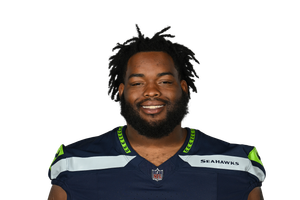
Anthony
Bradford.
 LSU· 6'4"· 332 lb· 5.08s 40
"One full season of college tape and 332 pounds of point-of-attack power: Bradford was drafted less for what he had done than for how little of it he needed to do it well."Pre-draft read
Bradford is a mass-and-torque right guard who plays low for 332 pounds. He works from a wide base with short first steps, and his punch arrives while his hips are still underneath him, so contact rarely knocks him off his track. In the LSU gap run game he was the displacement piece: down blocks, doubles climbing to the second level, short-yardage push.
The secondary trait is anchor. When a bull rush catches him his weight distributes backward instead of stacking forward, and he resets his feet mid-rep rather than surrender depth. Lateral range caps him — he is no puller who wins footraces, and quick interior rushers make him work. The signature is angle blocking: once his shoulder clears a defender's frame, the rep is finished.
Gap and duo run game with a heavy dose of down blocks and short-yardage displacement, paired with a quick-game passing plan that shortens his protection reps.
Year 1: swing interior backup who competes for the right guard job by midseason. Ceiling: entrenched multi-year starting guard on a physical run-first line.
An outside-zone offense that asks him to reach the play-side shade on the move and pull flat across the formation on split-zone and toss.
Keep him at one spot, point him downhill, and the value shows up immediately.
LSU G Anthony Bradford in 10 plays
Cut-up of ten representative reps showing the down-block power and anchor that defined his 2022 tape.
Anthony Bradford LSU
College highlight reel of his right guard work in the LSU gap run game.
Anthony Bradford 2021 LSUOdyssey profile
2021 profile piece covering the season that ended early by injury after five starts.
A four-star Michigan recruit who arrived at LSU as a tackle and finished as a guard, Bradford is a power-scheme interior blocker in the most literal sense. He is built low and thick, plays with natural knee bend for his size, and his best football happens inside a phone booth where his strength decides the rep before technique has to. Nothing about the profile is finesse; everything about it is force applied on a short track.
The production is real but thin. He redshirted in 2019 with three appearances, played seven mostly special-teams games in 2020, then broke through with five starts in the first six games of 2021 before injury ended his year. His only full season came in 2022: 13 games, 12 starts, 899 snaps with 736 at right guard, four sacks allowed and two penalties. Clean tape for a first-year starter — and the entire body of evidence.
Boards read him accordingly: a Day 3 developmental guard with starter traits and a thin résumé, projected across the fourth-to-seventh range. The rest of the pitch was frame and testing — 332 pounds with a 5.08 forty. Seattle at 108 was betting a defined gap-run identity could buy the traits early and coach the experience later.
- 01
Point-of-attack power
sinks his hips and delivers a punch with his weight behind it, routinely displacing SEC nose tackles off the midline on down blocks.
- 02
Natural anchor
absorbs bull rushes by distributing weight backward rather than stacking forward, and can reset his feet mid-rep instead of surrendering the pocket.
- 03
Angle and combo blocking
once his shoulder clears a defender's frame the rep is decided; he finishes doubles cleanly before climbing to the linebacker level.
- 04
Clean 2022 tape
899 snaps in his only full season with four sacks allowed and two penalties, which is unusually disciplined for a first-year starter.
- 05
Testing for the mass
5.08 forty and a 30-inch vertical at 332 pounds signal enough short-area burst to work up to the second level in a gap scheme.
- 01
Lateral range
he is not a puller who wins footraces to the edge, and reach blocks in a wide-zone system regularly ask him to cover ground he does not cover.
- 02
Quickness in space
twitchy interior rushers who counter off his first punch can beat him with a second move before his feet catch up to the rush.
- 03
Thin résumé
one full college season as a starter, with 2021 cut short by injury, leaves large parts of his projection resting on traits rather than evidence.
- 04
Pad level drift
when the rep extends past the first two seconds he rises out of his stance, and the same mass that anchors him becomes leverage to be used against him.
— — — positional median (p50)
- 40 yd
- 5.08sp50
- Vertical
- 30inp50
- Broad jump
- 106inp50
- Three-cone
- 7.84sp50
- Shuttle
- 4.80sp50
- Bench
- —rep
| Yr | Team | G |
|---|---|---|
| 2019 | LSU | 3 |
| 2020 | LSU | 7 |
| 2021 | LSU | — |
| 2022 | LSU | 13 |
| Career | — | 23 |
Offensive linemen do not accumulate box-score statistics. Games and starts listed only where an official source publishes them; unpublished 2021 appearances are left null rather than zero-filled.
A dash means the figure is not published by a source we trust — never a zero we invented.
Heavy, powerful interior starter who wins with mass and anchor, holds a job for years, and never needs to be a moving-target blocker.
A durable, low-leverage right guard whose value is dependability at the point of attack rather than movement skill — the realistic best version of this profile.
Same body type and drive-block traits, but the pad-level and quickness limitations win out and the player never locks down a starting job.
Everything above is the pre-draft evaluation. This section is what actually happened — updated year over year.
Seattle got exactly the developmental curve it drafted. Bradford started 10 of the 14 games he played as a rookie in 2023, taking the right guard job outright and living through the growing pains a one-year college starter should be expected to live through. In 2024 he started all 11 games he appeared in before an ankle injury put him on injured reserve in late November; he was activated in January. Then came the season that settled the question: he started all 17 regular-season games in 2025 and all 20 games overall at right guard on a Seattle offensive line that allowed only 27 sacks, tied for fifth-fewest in the league, and finished the year as a Super Bowl LX champion.
The hindsight verdict is that the board was right about the traits and too cautious about the arc. Bradford was graded as a project because he had one full season of college tape, not because anyone doubted the power — and once a team gave him a defined gap-heavy role and left him at one position, the development happened on schedule. Forty-two games, thirty-eight starts and a ring in three seasons is a fourth-round pick outperforming his slot by a comfortable margin. The limitation scouts flagged never went away; Seattle simply built around it instead of asking him to be someone else.