Tyler
Smith.
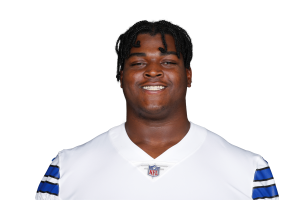
Tyler
Smith.
 Tulsa· 6'5"· 324 lb· 5.02s 40
"The nastiest run blocker in the class with the rawest hands, which is why the pick only made sense for a team with a real plan to move him inside and let the technique catch up."Pre-draft read
A 6-5, 330-pound left tackle who played with rare aggression, Smith attacked defenders instead of catching them. He fired off the ball in the run game, generated real displacement on down blocks and combinations, and finished plays past the whistle, which is exactly the temperament coaches love and officials do not. Power was never a question at any point on the tape.
Pass protection was raw. His hands landed late and wide, he lunged when a rusher gave him a two-way go, and his footwork got sloppy against speed off the edge. A steady stream of holding calls told the story of a young lineman playing faster than his technique allowed. The signature was violence: when he connected, defenders went backwards.
Gap and duo run game that lets him fire off the ball and displace defenders in a phone booth.
Year 1: starting left guard with the technique coached up inside. Ceiling: Pro Bowl guard or a left tackle if the hands catch up to the length.
Finesse pass-first offense that leaves him on an island in deep sets against premier speed rushers before his footwork is fixed.
Move him inside first and the flags become manageable while the power plays immediately.
THE TULSA TERMINATOR | OL Tyler Smith Tulsa NFL Draft Scouting Report
Scouting breakdown of his Tulsa tape and pass-set concerns.
Prospect Primer: Tyler Smith, OL, Tulsa
Pre-draft primer on his traits and positional projection.
Tulsa OL vs Ohio State Defense (2021)
Full-game line study against Power Five competition.
Smith was the most physically imposing and least refined offensive lineman worth a first-round pick. He arrived at Tulsa as a three-star recruit, started at left tackle as a redshirt freshman during the shortened 2020 season, and was first-team All-AAC before his 20th birthday. Teams were buying a young, enormous, mean lineman with 34-inch arms and a real chance to become a long-term starter at guard or tackle depending on how the hands developed.
The context mattered more than usual here. He was one of the youngest players in the class, with roughly two dozen college starts against American Athletic Conference competition, and his tape carried the flags that come with playing tackle before you are ready: a heavy holding count, most of it covering for late hands. He tested athletically enough at 5.02 in the forty with a 7.78 three-cone to keep the tackle projection alive, but most evaluators saw a guard.
Boards had him anywhere from the middle of the first round to the second. Dallas took him at 24 with a specific plan — start him at left guard, let the technique catch up in a phone booth, and keep tackle as an option later. It was an aggressive pick on age and traits over polish.
- 01
Play strength
Generates displacement on down blocks and combinations, moving defensive tackles off their landmarks rather than simply covering them up.
- 02
Temperament
Finishes blocks with intent and plays through the whistle, the kind of nastiness offensive line coaches cannot install in a veteran.
- 03
Length and frame
34-inch arms on a 6-5, 330-pound body give him the reach to recover in protection once his hand placement improves.
- 04
Age and upside
One of the youngest starters in the class with only two seasons of college tape, so the technical gap is a timeline rather than a ceiling.
- 05
Run-game versatility
Effective on gap, duo and zone concepts, comfortable pulling and climbing to linebackers with control at the second level.
- 01
Hand placement
Punches late and wide, which is why holding calls piled up as he grabbed to recover position he should have won at the point of contact.
- 02
Penalties
A heavy holding count across two seasons, a volume that will get a rookie benched if the technique does not clean up quickly in the NFL.
- 03
Pass sets
Lunges and overextends against a two-way go, losing his base when edge rushers threaten speed and then counter back inside.
- 04
Level of competition
Two years of starts in the American Athletic Conference, with few reps against the caliber of rusher he will see every Sunday.
— — — positional median (p50)
- 40 yd
- 5.02sp50
- Vertical
- 27.5inp50
- Broad jump
- 105inp50
- Three-cone
- 7.78sp50
- Shuttle
- 4.65sp50
- Bench
- —rep
| Yr | Team | G |
|---|---|---|
| 2019 | Tulsa | 4 |
| 2020 | Tulsa | 9 |
| 2021 | Tulsa | 13 |
| Career | — | 26 |
Offensive linemen do not accumulate box-score statistics; games and starts come from the Tulsa and published season records. Redshirted 2019 while playing the final four games with two starts, started all nine games at left tackle in the shortened 2020 season (first-team All-AAC), and started 12 of 13 games in 2021 (second-team All-AAC). Season totals sum to the career line.
A dash means the figure is not published by a source we trust — never a zero we invented.
Versatile young lineman who settles in at guard and can slide out to tackle in a pinch.
Overpowering left guard whose temperament and displacement define an offensive line.
Powerful college tackle whose hands and penalties keep him from locking down a starting spot.
Everything above is the pre-draft evaluation. This section is what actually happened — updated year over year.
Tyler Smith has been a versatile and dominant offensive lineman for the Dallas Cowboys, starting at both left tackle and left guard. He earned First-Team All-Pro honors in his second season.
Dallas got the plan right immediately. Smith started all 17 games at left guard as a rookie and made the PFWA All-Rookie Team, then settled in as one of the best guards in football, earning Pro Bowl recognition in each of the next three seasons and moving to left tackle late in 2025 when the roster needed him there. The penalties dropped, the power stayed, and he became the anchor of the line after the retirements of Tyron Smith and Zack Martin. In September 2025 the Cowboys signed him to a four-year, $96 million extension with $81.2 million guaranteed, briefly making him the highest-paid guard in the NFL.
In hindsight this was one of the best picks of the round and a template for drafting young offensive linemen. The concerns were all technical and all fixable, the traits and temperament were not teachable, and Dallas had a clear developmental plan instead of hoping the tackle projection worked out. Every team that passed on him at 24 watched him become a Pro Bowler by year two.
Data note: Imported from Wikipedia 2022 NFL draft player selections table.