Tyler
Linderbaum.
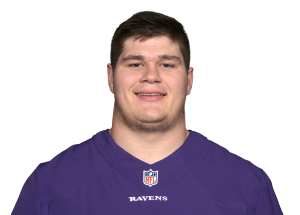
Tyler
Linderbaum.
 Iowa· 6'2"· 296 lb
"The best center prospect in a decade fell to 25 because he weighed 296 pounds with short arms, and the one team whose offense was built for him traded back into the first round to take him."Pre-draft read
A converted defensive lineman who became the best center in college football, Linderbaum played the position like an athlete who still thinks like a defender. He fired out of his stance with immediate leverage, reached nose tackles shaded to either side, and got to the second level faster than any interior lineman in the class, cutting off linebackers in the wide zone game.
In protection he was quick to set, precise with his hands and rarely late identifying pressure, running the front's communication with total command. The limits were physical: 296 pounds with 31-inch arms, which showed up when a heavy nose tackle got into his chest and drove him backwards. The signature was movement — snap, redirect, block a linebacker downfield.
Outside/wide zone running offense that asks the center to reach, climb and block linebackers in space.
Year 1: immediate starting center and protection caller. Ceiling: Pro Bowl pivot who makes a zone running game the identity of an offense.
Gap/power scheme that parks him head-up on a 340-pound nose tackle and asks him to win with mass on double teams.
He raises the ceiling of a zone offense and merely survives in a phone-booth one.
Tyler Linderbaum Official Highlights - Top Center in the Draft
Iowa tape showing reach blocks and second-level work.
MAN IN THE MIDDLE | Iowa C Tyler Linderbaum NFL Draft Report
Pre-draft scouting report on the size questions and the athleticism.
Tyler Linderbaum (Iowa) 2022 NFL Draft Film Study
All-22 study of his 2021 season.
Linderbaum was the cleanest evaluation in the class at a position teams have historically refused to draft in the top 25. Three years as Iowa's starting center, a unanimous All-American, the Rimington Trophy winner as the nation's best center, and tape that graded out among the highest of any offensive lineman scouts watched. The football was not the question at any point.
What made the process interesting was the body. He measured 6-2 and 296 pounds with 31.125-inch arms, dimensions that fall below what most teams set as thresholds for interior linemen, and he did not test at the combine. Iowa's outside-zone-heavy scheme fit him perfectly, which raised a fair question about how he would translate to a team asking its center to anchor against 340-pound nose tackles in a gap-blocking offense. Nobody doubted the technique, the intelligence or the athleticism; the doubt was leverage against mass.
Boards put him as the top center in the class and a top-20 talent, but position value pushed him down. Baltimore traded back into the first round with Arizona to take him at 25, a rare investment in the position by a team whose zone-running offense was built to maximize exactly what he does best.
- 01
Movement skills
The best athlete among interior linemen in the class, able to reach shaded nose tackles and cut off linebackers on wide zone with ease.
- 02
Second-level blocking
Climbs immediately and finds moving targets in space, turning short runs into long ones by erasing the linebacker level.
- 03
Snap quickness and leverage
Fires low out of his stance and gets his hands inside first, winning position before a bigger defender can settle.
- 04
Football intelligence
Ran Iowa's protection calls with command, identifying fronts and pressures accurately without needing help from the quarterback.
- 05
Production and pedigree
Three-year starter, unanimous All-American and Rimington Trophy winner, with the most consistent tape of any lineman in the class.
- 01
Anchor against mass
At 296 pounds he can be driven into the pocket by heavy nose tackles who get into his chest before he can reset his feet.
- 02
Arm length
31.125-inch arms let defenders reach his frame first, forcing him to win with quickness because he cannot win reach battles.
- 03
Scheme dependency
His best tape comes from an outside-zone offense; a gap-heavy scheme asking him to displace bodies is a poorer fit.
- 04
Testing gap
He did not run or jump at the combine, so teams graded his athleticism on tape alone with no measured baseline to confirm it.
| Yr | Team | G |
|---|---|---|
| 2018 | Iowa | 2 |
| 2019 | Iowa | 12 |
| 2020 | Iowa | 8 |
| 2021 | Iowa | 14 |
| Career | — | 36 |
Offensive linemen do not accumulate box-score statistics; games come from published season records and sum to 36. He arrived at Iowa as a defensive lineman in 2018 and moved to center for 2019, then started every game from 2019 through 2021; published sources differ on whether the 2019 count is 12 or 13 games, so 2019 starts are left unlisted rather than guessed.
A dash means the figure is not published by a source we trust — never a zero we invented.
Immediate plug-and-play starter and long-term top-five center in the league.
Undersized, hyper-athletic center whose movement redefines what a zone running game can do.
Smart, functional starter whose lack of anchor caps him as an average NFL center.
Everything above is the pre-draft evaluation. This section is what actually happened — updated year over year.
Tyler Linderbaum has been the starting center for the Baltimore Ravens since his rookie season, quickly becoming one of the league's top players at his position. He earned a Pro Bowl selection in his second year.
Baltimore plugged him in and never looked back. Linderbaum started all 17 games as a rookie and made the PFWA All-Rookie Team, then made the Pro Bowl in each of the next three seasons while anchoring the middle of the league's most productive rushing offense. The strength concerns showed up occasionally against elite nose tackles and mattered far less than the athleticism, which turned Baltimore's zone runs and quarterback-designed concepts into a weekly problem for opposing fronts. The Ravens declined his fifth-year option in April 2025 on cost grounds, and in March 2026 Las Vegas signed him to a three-year, $81 million deal with $60 million guaranteed.
In hindsight the arm length and weight thresholds cost teams a Pro Bowl center, and the team with the perfect scheme fit got him because the rest of the league was busy debating measurements. It is a clean hit at a position most front offices refuse to spend a first-round pick on, and the market later paid him like a premium starter.
Data note: from Buffalo / 2021 Rimington Trophy winner