
Skyy
Moore.
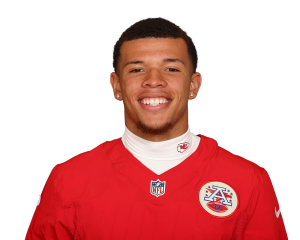
Skyy
Moore.
 Western Michigan· 5'10"· 195 lb· 4.41s 40
"A converted quarterback with the biggest hands in the class: Moore was the entire Western Michigan offense, which made him both the easiest receiver to grade and the hardest one to project."Pre-draft read
Inside-outside receiver, a converted high school quarterback who played every alignment Western Michigan had. Moore wins early: a compact, low-to-the-ground release package and 10¼-inch hands let him snatch the ball outside his frame and immediately turn upfield. He is best on slants, digs and shallow crossers, where his first two steps after the catch are dangerous in traffic.
The separation comes from tempo changes rather than pure burst — he stems defenders one way and snaps back the other, and a 1.46-second ten-yard split shows how fast he gets to top gear on short routes. Downfield he tracks the deep ball, but at 5-foot-10 he loses the jump-ball reps bigger receivers cash. The signature is toughness over the middle against zone.
Motion-heavy, quick-game spread offense that manufactures touches on slants, shallow crossers and jet sweeps and lets the receiver create after the catch.
Year 1: movable slot on a manufactured-touch package plus punt returns. Ceiling: 90-catch inside receiver who is the engine of a quick passing game.
An isolation-heavy offense that asks its receivers to beat press on the boundary and win contested throws downfield, where his frame is a hard cap.
He needs schemed volume; he does not create his own targets against tight coverage.
Western Michigan WR Skyy Moore 2021 Highlights
Breakout-season cutups: hands away from the frame, shallow crossers and yards after the catch.
Skyy Moore 2021 Highlights | Western Michigan WR
Full 2021 reel showing slot and boundary alignments plus jet-motion touches.
Skyy Moore | Western Michigan Broncos 2019 Highlights
True-freshman tape from the season he moved off quarterback and started producing immediately.
Moore was the whole offense at Western Michigan, and that is both the sell and the caution. A quarterback in high school who arrived as a lightly recruited slot, he grew into the target every coverage keyed on, running the full route tree from the slot, from the boundary and out of the backfield in jet motion.
The 2021 tape is a volume-and-craft season: 96 catches for 1,293 yards and ten touchdowns in twelve games, more than half of a MAC offense's passing production in one player. The signature trait was the hands — he plucked away from his body with the biggest hands in the class — and the yards after the catch that turned five-yard throws into first downs. The flags were the level of competition, a slight frame and a three-cone time that suggested he was quicker in a straight line than truly sudden.
Boards had him as the WR5–WR8 of a deep class, a late-first to early-second grade, with the debate centering on whether he was a true starting X or a high-volume slot. Kansas City took him at 54 in the offseason it traded Tyreek Hill, an unmistakable message about the role they projected.
- 01
Rare hands
Ten-and-a-quarter-inch hands, the biggest in the class, let him pluck throws outside his frame and secure contested catches over the middle without body-trapping.
- 02
Yards after the catch
First two steps after securing the ball are dangerous in tight space; he breaks arm tackles and turns short crossers into first downs on a weekly basis.
- 03
Instant acceleration
A 1.46-second ten-yard split ranked near the top of the class and shows on tape as an ability to reach top gear before the corner can open his hips.
- 04
Alignment versatility
Played slot, boundary and jet motion out of the backfield, giving a play-caller a receiver who can be moved to attack whichever matchup is worst.
- 05
Toughness over the middle
Works the dig and shallow-crosser windows without alligator arms, taking hits from safeties and still finishing the catch through contact.
- 01
Size ceiling
At 5-foot-10 with 31-inch arms he loses the jump-ball and back-shoulder reps that bigger boundary receivers convert, capping his red-zone value outside.
- 02
Level of competition
MAC coverage rarely challenged him with NFL-caliber press or bracket looks, so the projection leaned on traits rather than on tested tape.
- 03
Limited long-speed threat
Fast to top gear but not a true field-stretcher; he does not consistently run past NFL corners, which narrows the vertical part of his route tree.
- 04
Volume-dependent production
Nearly a third of the offense's targets ran through him, so it was hard to know how the tape would read as a third or fourth option.
— — — positional median (p50)
- 40 yd
- 4.41sp50
- Vertical
- 34.5inp50
- Broad jump
- 125inp50
- Three-cone
- 7.13sp50
- Shuttle
- 4.32sp50
- Bench
- —rep
| Yr | Team | G | Rec | Yds | TD |
|---|---|---|---|---|---|
| 2019 | Western Michigan | 13 | 51 | 802 | 3 |
| 2020 | Western Michigan | 5 | 25 | 388 | 3 |
| 2021 | Western Michigan | 12 | 96 | 1293 | 10 |
| Career | — | 30 | 172 | 2483 | 16 |
cfbstats verified 2020 (5 G, 25-388-3) and 2021 (12 G, 96-1,293-10); 2019 (13 G, 51-802-3) from the StatMuse season table. Season sums give 172-2,483-16 receiving over 30 games; StatMuse's career line of 170-2,473-17 includes a rushing touchdown and differs slightly on receiving totals, and that discrepancy is unresolved.
A dash means the figure is not published by a source we trust — never a zero we invented.
A manufactured-touch slot who needs schemed volume to matter and lives in the third-receiver role.
The ceiling is a high-volume interior receiver whose hands and quickness make him a chain-mover in every situation.
The floor is a highly drafted slot who ends up living on return duty and roster depth instead of offense.
Everything above is the pre-draft evaluation. This section is what actually happened — updated year over year.
Skyy Moore has played his entire career with the Kansas City Chiefs, primarily as a rotational wide receiver and punt returner. He was part of a Super Bowl-winning team.
Kansas City drafted him into a receiver room being rebuilt from scratch and never found a stable role for him. His rookie year produced 22 catches for 250 yards with no touchdowns across 16 games plus punt-return duty, and his most remembered snap of the season was a Super Bowl LVII catch, not a body of work. The second year was almost identical — 21 receptions, 244 yards, one score — and the third collapsed entirely: six games, three targets, no catches. San Francisco claimed him in 2025 and repurposed him as a kick and punt returner, where he finally produced real volume — 907 kickoff-return yards on 33 attempts — while catching only five passes. He signed on in Green Bay after that.
The pre-draft flag that mattered was not the level of competition; it was the projection. Everyone graded the hands and the yards after the catch correctly, and both showed up in the NFL when he got targets. What the evaluation underweighted was how much of his college value came from being schemed the ball twelve times a game — take that volume away and the traits alone did not win jobs. He became a special-teams contributor rather than a receiver, which for pick 54 is a miss.
Data note: from New England