Joshua
Ezeudu.
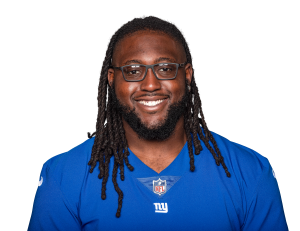
Joshua
Ezeudu.
 North Carolina· 6'4"· 308 lb· 5.19s 40
"A four-position North Carolina blocker with genuine pulling speed and a finishing streak, whose pass sets were still unbuilt — the whole pick was a bet that NFL coaching could fix the feet before the versatility ran out."Pre-draft read
Interior blocker built like a tackle who spent his college career sliding across the line. He plays with a wide, powerful base and a violent first punch, and in the run game he is at his best pulling and climbing — the athleticism that shows up when he has a runway is the trait that got him drafted.
Pass protection is the unfinished half. He sets with heavy feet and a high pad level, and rushers who cross his face or work half-man can knock him off balance before he resets his hands. The recovery strength is real and he rarely loses the same rep twice, but the consistency swings. The signature is versatility with force: guard, tackle, either side, and a mean streak once he gets his hands inside.
Gap and power run game that pulls its guards and asks them to move bodies, paired with a quick-game passing structure that shortens his pass sets.
Year 1: swing interior backup with tackle emergency value. Ceiling: multi-year starting guard in a downhill run scheme.
Deep-drop passing offense that leaves him isolated on quick interior rushers for a full three-step set every snap.
His value curve rises with every pulling concept the offense runs and falls with every long-developing dropback.
Joshua Ezeudu NFL Draft Tape | North Carolina OL
ACC Digital Network cut-up of his Tar Heels tape: pulls, climbs and the pass sets that decided the grade.
Giants OL Joshua Ezeudu Film Breakdown (UNC 3rd Round)
Post-draft film breakdown walking through the versatility case and the technique clean-up ahead of him.
Joshua Ezeudu film study: Potential starting LG for Giants
Big Blue View study of his guard reps, hand timing and anchor against interior rushers.
A four-year North Carolina lineman who never settled into one job and was valued for exactly that. He was a guard by build and temperament, moved out to left tackle when the roster demanded it, and left Chapel Hill as the kind of tough, athletic, position-flexible blocker teams keep on a 53-man roster because he can cover three spots on a Sunday.
The context matters more than usual here. He played on a Tar Heels front that was among the worst pass-protecting units in the country in 2021, and the tape has to be read with that around him. What survived the noise was the movement: he pulls with real speed, gets to the second level cleanly, and finishes when he arrives. What did not survive was pass-set consistency — the pad level rises, the hands come late, and interior counters got home more often than a Day 2 grade wants.
Boards had him as a third-round interior developmental piece with tackle emergency value, and the athletic testing at 6-4 1/2 and 308 backed the projection. The Giants took him at 67 as a swing lineman with a starting future inside, betting that scheme and coaching could clean up the technique that college never did.
- 01
Pulling athleticism
moves with real speed on power and counter, arrives at the second level under control and can cut off a backside linebacker in space.
- 02
Positional flexibility
logged snaps at both guard spots and at left tackle, the kind of cross-training that turns a reserve into a game-day active every week.
- 03
Finishing temperament
plays with a mean streak once his hands land inside, and he works to bury a defender rather than settle for a stalemate.
- 04
Recovery strength
heavy enough through the hips to reset a rep that starts badly, dropping his anchor and walking a rusher past the pocket.
- 05
Frame and length
tackle-sized build with 34-inch arms, which is why teams were willing to keep the emergency swing-tackle option on the table.
- 01
Pass-set footwork
heavy, imprecise first steps let quick interior rushers cross his face, and he has to catch up with his hands instead of meeting contact on his terms.
- 02
Pad level
rises out of his stance and plays tall, which surrenders leverage against strong bull rushers and turns anchor reps into slow retreats.
- 03
Hand timing
punches early or late rather than in rhythm, so his strike lands on shoulder pads instead of the chest and defenders slip the block.
- 04
Environment noise
he played inside one of the country's shakiest pass-protection units, which makes it harder to separate his technique flaws from the reps around him.
— — — positional median (p50)
- 40 yd
- 5.19sp50
- Vertical
- 28.5inp50
- Broad jump
- 105inp50
- Three-cone
- 7.83sp50
- Shuttle
- 4.56sp50
- Bench
- —rep
| Yr | Team | G |
|---|---|---|
| 2018 | North Carolina | 1 |
| 2019 | North Carolina | 13 |
| 2020 | North Carolina | 9 |
| 2021 | North Carolina | 12 |
| Career | — | 35 |
Offensive linemen do not accumulate box-score production; appearances come from Tankathon North Carolina game logs (2018 1, 2019 13, 2020 9, 2021 12; sum 35). Verified start counts by season were not available from a primary source, so they are left null rather than estimated.
A dash means the figure is not published by a source we trust — never a zero we invented.
A rotational interior lineman who gives a line real weeks of competent starting play without owning the job.
The ceiling case is a big, athletic multi-spot starter whose length lets a team survive a tackle injury.
The floor is a Day 2 pick whose technique never catches up and who survives on versatility and roster math.
Everything above is the pre-draft evaluation. This section is what actually happened — updated year over year.
Joshua Ezeudu has played two seasons for the New York Giants, seeing action as a reserve offensive lineman. He has dealt with injuries and has not yet established himself as a starter.
The Giants used him exactly like the profile suggested — as a fill-in wherever the line broke. He played ten games with two starts as a rookie, then six games with five starts in year two, most of them at left tackle rather than the guard spot he was drafted to play. Year three was his most available season: seventeen games, three starts, mostly as a sixth lineman and injury insurance. A training-camp injury in 2025 put him on injured reserve, where he stayed the entire season without suiting up once. The Giants brought him back on a one-year deal in March 2026 under a new staff, then traded him to Kansas City in late August 2026 for a 2028 pick, closing four New York seasons at thirty-three games and ten starts.
The evaluation got the player right and the timeline wrong. Everyone saw a tough, athletic, versatile lineman whose pass sets needed rebuilding, and four years later the pass sets still had not been rebuilt enough to win a starting job. Asking him to play left tackle before the guard technique was fixed did not help. A third-round pick is supposed to become a starter; he became a valuable emergency piece instead, which is a real NFL job but not the one the pick paid for.
Data note: Imported from Wikipedia 2022 NFL draft player selections table.