Drake
Jackson.
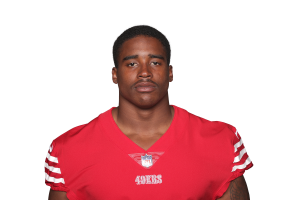
Drake
Jackson.
 USC· 6'3"· 254 lb
"A five-star athlete whose bend around the corner was the best in the class and whose play strength never caught up, making him exactly the kind of second-round bet that pays off only with a plan and patience."Pre-draft read
A bendy stand-up edge who wins with first-step quickness and corner flexibility rather than power. Jackson aligns wide, gets off the ball in a hurry, and attacks the outside shoulder with a rip and a lean that lets him flatten to the quarterback without losing speed. He is comfortable on his feet in space and can be moved inside on passing downs to hunt a guard.
The run defense is the weaker half of the story. He sets the edge with technique more than mass, and when a tackle gets into his frame the anchor gives. His counters are a work in progress — the plan is usually speed first, speed again. The signature is the bend: few players in the class could turn the corner at that angle.
Attacking four-man front with a designated third-down rush package that lets him pin his ears back from a wide alignment instead of holding an edge on early downs.
Year 1: rotational speed rusher on obvious passing downs. Ceiling: a starting weak-side end who converts the bend into double-digit sacks once his hands catch up.
A two-gap odd front that asks him to hold the point against tight ends and tackles on early downs, where his anchor disappears and the athletic advantage never gets used.
He needs a defined pass-rush job, not a full-time edge-setting role.
Drake Jackson — USC career highlights
The full college reel: get-off, the rip move, and the corner flexibility that made him a second-round athletic bet.
Drake Jackson — USC 2021 highlights
His junior season, the tape teams graded most closely: five sacks, eight tackles for loss, and the run-defense limits.
Drake Jackson — 2022 rookie season highlights
Rotational rookie work in San Francisco, the only healthy stretch of his NFL career so far.
A three-year USC starter who arrived as a five-star recruit and spent his college career as a slightly undersized edge asked to do a bit of everything: rush from a two-point stance, set an edge against Pac-12 tackles, and occasionally drop into coverage. The traits were never in question — burst, flexibility, natural athleticism — but the frame at 6-4 and 255 pounds meant the play strength always trailed the movement skills.
Production peaked early. His freshman season in 2019 was his most disruptive: forty-six tackles, twelve tackles for loss and five and a half sacks in eleven games. The shortened 2020 gave him six games and two sacks, and as a junior in 2021 he posted thirty-seven tackles, eight tackles for loss and five sacks on a team going nowhere. Twenty-eight career games, twelve and a half sacks, more flashes than sustained dominance, and a body that changed shape more than once in three years.
Boards had him in a familiar bucket: a second-round athletic bet on a pass rusher whose best football was ahead of him if a staff could add power and a plan. Testing supported it — a thirty-six-and-a-half-inch vertical and a one-hundred-twenty-seven-inch broad at that length. San Francisco took him at 61 to be the developmental speed rusher behind an established front.
- 01
Corner flexibility
Bends around the arc at an angle most edges cannot reach, flattening to the quarterback without decelerating once he beats the tackle's outside shoulder.
- 02
Get-off
Times the snap well and covers ground in his first two steps, which forces tackles into hurried, oversetting pass sets before the rush plan even begins.
- 03
Rip move
Has a genuinely functional rip that clears his outside arm and keeps him clean, the one refined technique in an otherwise trait-based rush toolkit.
- 04
Scheme versatility
Comfortable in a two-point stance, with his hand down, or reduced inside on passing downs, so he fits a four-man front or an odd front.
- 05
Freshman disruption
Twelve tackles for loss and five and a half sacks as a true freshman in the Pac-12, evidence the burst translated against real tackles immediately.
- 01
Play strength
Gets moved off the spot when a tackle gets hands inside his frame, and the anchor against down blocks is the reason he was a liability on early downs.
- 02
Rush plan
Leans on speed and the rip without a reliable counter, so once a tackle respects the outside track he runs out of answers on the same rep.
- 03
Production curve
His most disruptive season was his first, and the sack totals never grew with his experience despite a heavier pass-rush snap share.
- 04
Body composition
Fluctuated between weights across three seasons without settling on a frame that supported both the bend and the strength his position demands.
— — — positional median (p50)
- 40 yd
- —s
- Vertical
- 36.5inp50
- Broad jump
- 127inp50
- Three-cone
- —s
- Shuttle
- —s
- Bench
- —rep
| Yr | Team | G | Tkl | Sk | Int | PD | FF |
|---|---|---|---|---|---|---|---|
| 2019 | USC | 11 | 46 | 5.5 | 0 | 3 | 1 |
| 2020 | USC | 6 | 20 | 2 | 1 | 0 | 0 |
| 2021 | USC | 11 | 37 | 5 | 1 | 1 | 1 |
| Career | — | 28 | 103 | 12.5 | 2 | 4 | 2 |
2020 and 2021 verified against cfbstats (USC team 657, player 1105472); 2019 is not hosted there and comes from the full-career table. One discrepancy: cfbstats lists 5.5 tackles for loss in 2020 while the career table lists 6.0, so the career total here is 25.5 rather than 26. cfbstats publishes no passes-broken-up or forced-fumble line for 2020, so those are left blank rather than recorded as zero.
A dash means the figure is not published by a source we trust — never a zero we invented.
The realistic outcome is a rotational rusher whose production is real in flashes and repeatedly interrupted by lower-body injuries.
The ceiling is a pure speed rusher who never fixes the run defense but becomes worth real money because of what he does on third down.
The floor as it played out: an athletic edge whose career is defined by a major lower-body injury rather than by his tape.
Everything above is the pre-draft evaluation. This section is what actually happened — updated year over year.
Drake Jackson has played two seasons for the San Francisco 49ers as a rotational defensive end. He has shown flashes but has not yet secured a consistent starting role.
The rookie year read like the plan working: fifteen games in a rotational role, three sacks, and enough flashes in the first month that his snap share looked ready to grow. Year two started the same way — three more sacks in eight games — and then ended in November 2023 with a knee injury that turned out to be a torn patellar tendon. He did not play in 2024 at all, was released and worked out for teams through 2025, and finally got back on the field for three games with Washington late that season. Washington re-signed him to a one-year deal in March 2026.
This is the version of the athletic-edge gamble that does not pay. The evaluation flagged the play strength and the missing counters, and those were fair, but the actual outcome was decided by an injury nobody projected: six sacks in twenty-three games, then two years of rehab and roster limbo. He is still on an NFL roster and still young enough for the story to change, but as a second-round pick used on a pass rusher, the return has been close to nothing.
Data note: Imported from Wikipedia 2022 NFL draft player selections table.