Cam
Taylor-Britt.
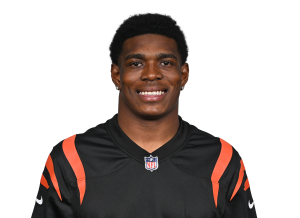
Cam
Taylor-Britt.
 Nebraska· 5'11"· 196 lb· 4.38s 40
"A converted quarterback turned boundary corner who wins with contact and closing burst, and whose grabby hands and late ball location were always going to decide whether he was a starter or a liability."Pre-draft read
A press-happy outside corner who plays the position like a safety who learned to cover. Taylor-Britt lines up on the boundary, gets his hands on receivers at the line, and mirrors with short, choppy feet. He is comfortable in off-man and in zone with his eyes on the quarterback, and his best trait is closing burst: once he reads a throw in front of him he arrives with bad intentions.
The second trait is the run fit. He takes on blocks instead of avoiding them, sheds tight ends with genuine strength, and tackles like a hitter. Speed is real — a 4.38 forty — but the game speed shows up more in his trigger than his carry down the sideline. The signature is aggression: he wants the collision, at the catch point and in the alley.
Press-man defense that lets him play at the line of scrimmage on the boundary and keeps his eyes on the receiver rather than in the backfield.
Year 1: outside starter in a press-heavy defense with safety help over the top. Ceiling: a physical CB2 whose ball production makes him a plus starter on a playoff defense.
A pure off-coverage, eyes-in-the-backfield match system that leaves him isolated on vertical routes, where his late ball location becomes a weekly problem.
Give him a receiver to hit at the line and he thrives; ask him to run and turn without contact and he leaks.
Cam Taylor-Britt — Nebraska highlights
College reel that shows the base of the evaluation: press contact at the line, downhill trigger, and the physical run support.
Cam Taylor-Britt — 2022 rookie season highlights
First NFL season on the boundary in Cincinnati, the year he took the job over midway through the schedule.
Cam Taylor-Britt — 2024 season highlights
His highest-volume NFL season: seventeen games, three interceptions and sixteen passes defended, plus the lapses that came with it.
A four-year Nebraska starter who arrived as a high-school quarterback, spent time at safety, and settled at boundary corner as a junior. That path shows: he plays with the physicality of a defender who used to live closer to the ball, and the ball skills of someone who has read quarterbacks from both sides of the line of scrimmage.
Production came in waves rather than a straight line. He was a nine-game contributor as a freshman in 2018, broke out in 2019 with forty-nine tackles, three interceptions, a pick-six against Iowa and four forced fumbles, then handled a shortened 2020 with two more picks. As a senior captain in 2021 he posted his cleanest coverage season — fifty-one tackles, eleven passes defended, one interception — and second-team All-Big Ten honors. Forty career games, one hundred forty tackles, six interceptions, twenty-one passes broken up.
Boards were split on the projection more than the player. He tested well at the Combine — a 4.38 forty at 196 pounds — and evaluators liked the toughness, but grades ranged from late second to fourth round because the technique got grabby and the deep-ball tracking was inconsistent. Cincinnati traded up in the second round and took him at 60 to add press coverage to the boundary.
- 01
Press physicality
Wants contact at the line and has the functional strength to reroute receivers off their stem, which lets him play tight, disruptive coverage on the boundary.
- 02
Closing burst
Reads throws in front of him and drives on the ball hard, arriving at the catch point in time to force incompletions rather than settling for the tackle.
- 03
Run support
Takes on blockers instead of running around them, sheds tight ends and slot receivers, and finishes tackles in the alley like a defender who enjoys the collision.
- 04
Ball production
Six college interceptions, twenty-one passes broken up and four forced fumbles, with a pick-six against Iowa that showed what he can do with the ball in his hands.
- 05
Timed speed
Ran 4.38 at 196 pounds, so the athletic floor supports outside corner duty rather than a projected move to safety despite the physical style.
- 01
Grabby technique
Relies on hands beyond the legal window when a receiver stacks him, a habit that turns contested reps into flags against NFL officiating standards.
- 02
Deep-ball tracking
Late to locate the football on vertical routes, which turns coverage wins into completions when he is forced to run and find the throw at the same time.
- 03
Route-recognition lapses
Can be baited by double moves and stems when he plays with his eyes in the backfield, giving up separation he does not have the length to recover.
- 04
Aggression cost
The same trigger that produces splash plays drags him out of position on play-action and misdirection, and his tackling angles get too flat in space.
— — — positional median (p50)
- 40 yd
- 4.38sp50
- Vertical
- —in
- Broad jump
- —in
- Three-cone
- —s
- Shuttle
- —s
- Bench
- —rep
| Yr | Team | G | Tkl | Sk | Int | PD | FF |
|---|---|---|---|---|---|---|---|
| 2018 | Nebraska | 9 | 12 | 0 | 0 | 3 | 0 |
| 2019 | Nebraska | 11 | 49 | 1.5 | 3 | 3 | 4 |
| 2020 | Nebraska | 8 | 28 | 0 | 2 | 4 | 0 |
| 2021 | Nebraska | 12 | 51 | 1 | 1 | 11 | 0 |
| Career | — | 40 | 140 | 2.5 | 6 | 21 | 4 |
2020 and 2021 verified against cfbstats (Nebraska team 463, player 1095903); 2018 and 2019 are not hosted there and come from the full-career table, which reconciles exactly with the career line: 140 tackles, 9 TFL, 2.5 sacks, 6 interceptions, 21 passes defended, 4 forced fumbles, 2 recoveries in 40 games. One interception returned for a touchdown, against Iowa in 2019.
A dash means the figure is not published by a source we trust — never a zero we invented.
The realistic outcome is a starting boundary corner with real takeaway production and enough bad reps to keep him on the move.
The ceiling is a physical, ball-producing corner who becomes the personality of a secondary and plays a decade of meaningful snaps.
The floor is a physically gifted starter whose penalties and lapses make him a target every week and shorten his stay in each building.
Everything above is the pre-draft evaluation. This section is what actually happened — updated year over year.
Cam Taylor-Britt has played his entire career with the Cincinnati Bengals, developing into a starting cornerback. He has been a key contributor in the Bengals' secondary.
Cincinnati eased him in and then handed him the job: he did not start early as a rookie but was on the field for ten games and fifty-five tackles once he took over the boundary spot. Year two was the leap — four interceptions in twelve games, eleven passes defended, a return touchdown. In 2024 he played all seventeen games and posted his biggest volume season with seventy-seven tackles, three picks and sixteen passes defended, though the coverage tape was noisier than the counting stats. Then 2025 came apart: eight games, an injury that ended his season, and a legal matter off the field. He left Cincinnati in free agency and signed with Indianapolis, then served a one-game suspension under the personal conduct policy.
The evaluation was accurate about the player and generous about the trajectory. Everything scouts flagged — the grabbiness, the deep-ball issues, the aggression that cuts both ways — is exactly what has capped him, and the traits they loved are why he still started three-plus seasons in a good defense. He is what a late-second-round corner is supposed to be: a real starter for a stretch, never a lockdown one.
Data note: from Tampa Bay via Buffalo