Cam
Jurgens.
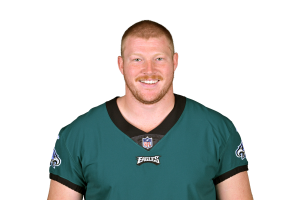
Cam
Jurgens.
 Nebraska· 6'3"· 303 lb· 4.92s 40
"A four-star tight end recruit who moved to center as a redshirt freshman, then sat two years behind Jason Kelce before replacing him and making the Pro Bowl."Pre-draft read
Zone-scheme center built like an athlete, not a mauler. A converted tight end, he plays with rare foot speed for the position: he reaches nose tackles on wide zone, climbs to linebackers on the second level and pulls on split flow like a fullback. Nebraska ran a lot of movement up front specifically because he could get there.
In pass protection he is quick to depth and smooth on slides, with the recovery quickness to reset when the first punch misses. The issue is anchor — at 303 pounds with a shorter frame he can get walked back by a heavy nose, and his snaps in the shotgun were an ongoing problem. The separator is the movement skill; there was not a more athletic center in the class.
Wide-zone and mid-zone run game with movement concepts, in an offense willing to protect a center with strength on either side
Year 1 swing interior backup and special-teams contributor while adding functional strength; ceiling is a Pro Bowl zone center who anchors a top offensive line
A gap-and-power system that asks a center to double-team a 340-pound nose on early downs and win the line of scrimmage by mass
His value multiplies next to strong guards who can help on the heaviest interior rushers.
Cam Jurgens Highlights | 2022 NFL Draft | Philadelphia Eagles
Pre-draft cut-up: reach blocks, second-level climbs and pull reps at Nebraska.
CENTER OF THE CORN | Cameron Jurgens Nebraska C NFL Draft Profile
Draft profile breaking down the tight end conversion and his zone-blocking fit.
Film Room 114 - Cam Jurgens
Film-room breakdown of his technique, anchor limits and movement skill.
Jurgens is a 6-foot-3, 303-pound center from Nebraska and one of the most unusual line prospects in the class: a four-star tight end recruit who moved to center as a redshirt freshman and anchored the middle of the line for three years in the Big Ten. Everything about the evaluation runs through that conversion.
He played 32 games across four seasons — 12 in 2019, seven in the shortened 2020 and 12 more in 2021 — as one of the few stable pieces on a struggling Nebraska team. The signature reps are on the move: reaching a shaded nose, climbing to a will linebacker in space, pulling on a counter. He tested to match with 25 bench reps and rare short-area quickness for the position. The flags are real: a functional strength deficit against big nose tackles, and repeated snapping issues from the gun that showed up on national television.
Boards had him in the second- to third-round range as a scheme-specific zone center. Philadelphia took him at 51 with an unusual plan: sit him behind Jason Kelce for two years and let him learn the job.
- 01
Movement skill
a converted tight end with the foot speed to reach shaded nose tackles, climb to the second level and pull on split-flow runs.
- 02
Zone-blocking fit
his best reps come on outside and mid zone, where he can win with angles and leverage rather than raw mass at the point.
- 03
Second-level blocking
locates and fits linebackers in space, which is the hardest thing to teach and the reason he tests as a scheme centerpiece.
- 04
Recovery quickness
when the first punch misses he resets his feet and hands fast enough to stay in front rather than losing the rep outright.
- 05
Toughness and finish
plays with a nasty streak, works to the whistle and looks for extra work once his assignment is sealed.
- 01
Anchor
at 303 pounds he can be walked into the quarterback by a heavy nose tackle, and bull rushes remain the cleanest way to beat him.
- 02
Snapping consistency
repeated errant shotgun snaps at Nebraska put drives in bad spots and are the first thing an NFL staff has to fix.
- 03
Scheme dependency
the tools are built for a zone-heavy run game, and a gap-and-power system would ask him to do the thing he does worst.
- 04
Positional experience
only three years at center after converting from tight end, so the mental side of the job is still developing.
— — — positional median (p50)
- 40 yd
- 4.92sp50
- Vertical
- —in
- Broad jump
- —in
- Three-cone
- —s
- Shuttle
- —s
- Bench
- 25repp50
| Yr | Team | G |
|---|---|---|
| 2018 | Nebraska | 1 |
| 2019 | Nebraska | 12 |
| 2020 | Nebraska | 7 |
| 2021 | Nebraska | 12 |
| Career | — | 32 |
Offensive linemen do not accumulate box-score statistics, so the record here is participation only. His season ledger lists 1 game in 2018, 12 in 2019, 7 in the shortened 2020 season and 12 in 2021, reconciling to 32 career games. Start counts are not published in the sources used, so they are left blank rather than estimated. He was a four-star tight end recruit who converted to center as a redshirt freshman.
A dash means the figure is not published by a source we trust — never a zero we invented.
Tough interior starter who takes a couple of years to settle in and then holds a job for a long time.
Undersized athletic center who becomes an All-Pro by winning with movement in a zone-heavy run game.
Serviceable zone center whose anchor limits keep him from ever being more than a middling starter.
Everything above is the pre-draft evaluation. This section is what actually happened — updated year over year.
Cam Jurgens has played his entire career with the Philadelphia Eagles, starting at right guard in his second season after being a backup center as a rookie. He has been a consistent starter on the offensive line.
Philadelphia executed the plan exactly. He played all 17 games as a rookie in 2022 in a backup and special-teams role behind Jason Kelce, then took over at right guard in 2023 and started 11 games. When Kelce retired he moved to center in 2024, started 16 games, made the Pro Bowl in his first year as a starting center and won Super Bowl LIX. He was back in 2025 for 14 games and 14 starts, earning a second consecutive Pro Bowl while working through back problems, and started the playoff game.
This is one of the best picks of the round. The anchor concern was legitimate and the Eagles solved it by putting him in a zone-heavy system next to elite guards and by giving him two full years to add strength before he ever had to be the answer. The snapping problem never followed him to the NFL. Two Pro Bowls, a ring and a five-year run as a starter is an outcome nobody had on the board at 51, and it happened because a team matched a scheme-specific player to the exact scheme he needed.
Data note: Imported from Wikipedia 2022 NFL draft player selections table.