Arnold
Ebiketie.
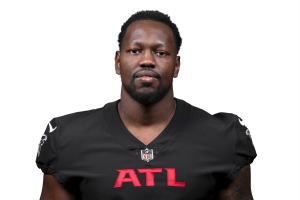
Arnold
Ebiketie.
 Penn State· 6'2"· 250 lb
"A one-year Big Ten breakout who arrived from Temple as a finished speed rusher: long-strided, relentless, and able to turn the corner on tackles who had never seen that kind of get-off."Pre-draft read
Stand-up and hand-in-the-dirt edge who wins first with take-off and pursuit angles. His get-off is the trait: he times the snap, eats the tackle's cushion in two strides and forces a pass set that is late and upright, then finishes with a long-arm or a clean arm-over when the blocker overcommits. The corner bend is real — he can drop his inside shoulder and flatten to the quarterback without gearing down.
Against the run he chases and spills rather than anchoring at the point of attack, playing with hands inside but giving ground to down blocks. The athletic ceiling shows up on stunts and in space, where he is one of the faster edge players in the class. The separator is motor: rep twelve looks like rep one.
Attacking four-man front or 3-4 outside linebacker in a sub-heavy defense
Year 1 designated pass rusher on 40-50% of snaps; ceiling is a starting speed rusher who wins the edge on early downs and closes games as an interior reducer
A two-gap 3-4 end asked to hold up against double teams on first and second down, or a defense that requires its ends to set a firm edge against heavy personnel
Best used with a stunt-heavy game plan that gets him running at a guard's outside shoulder.
Penn State DE Arnold Ebiketie 2021 Highlights
Full 2021 season reel: get-off, corner bend and backside chase.
Highlights: Penn State DL Arnold Ebiketie | Big Ten Football in the 2022 NFL Draft
Conference cut-up of his breakout Big Ten season.
Arnold Ebiketie (Penn State) 2022 NFL Draft Class Film Study
Rep-by-rep breakdown of his pass-rush plan and run-defense limits.
Ebiketie is a speed-to-power edge who became a first-round conversation in a single season at Penn State after three quiet years at Temple. His identity is pressure volume — he does not need a designed advantage to affect a pocket, and he wins from either side with take-off, hand quickness and a genuine finishing gear.
The production arc is the story. He was a rotational body in 2018 and 2019, broke out with a compressed six-game 2020 at Temple, then transferred and posted 18 tackles for loss and 9.5 sacks for the Nittany Lions in 2021. He blocked a field goal against Wisconsin in the opener and was the best defender on the field in the Iowa loss. The flags were weight and anchor: he played in the 250s, and offenses that ran directly at him could move him off his gap.
Boards had him in the back half of the first round to the top of the second, with rooms split between the pass-rush traits and the one-year sample against Power Five tackles. Atlanta, rebuilding a defense with almost no edge pressure, took the traits at 38 and asked him to rush first, hold up later.
- 01
Explosive get-off
times the snap as well as any edge in the class and turns that head start into an immediate pass-set problem for the tackle.
- 02
Corner bend
drops his inside shoulder and flattens to the quarterback without losing speed, which is the trait that turns pressures into sacks.
- 03
Hand quickness
chops, swipes and long-arms with real timing, and he keeps the blocker's hands off his frame long enough to work a second move.
- 04
Nonstop motor
chases plays down from the backside and finishes at the sideline, which shows up in his tackle-for-loss totals as much as his sacks.
- 05
Positional flexibility
comfortable standing up as an outside linebacker or with his hand down, and he can reduce inside on obvious passing downs.
- 01
Play strength
carried only 250 pounds at the combine and gets displaced by down blocks and doubles when offenses run right at his shoulder.
- 02
One-year Power Five sample
the entire high-level résumé is 12 games at Penn State after three modest seasons in the American Conference.
- 03
Run-game anchor
plays with too much chase and not enough patience, and he loses gap integrity when he guesses on the read side of a run.
- 04
Counter menu
when the first move fails he can stall against long-armed tackles instead of layering a second rush plan into the same rep.
— — — positional median (p50)
- 40 yd
- —s
- Vertical
- 38inp50
- Broad jump
- 128inp50
- Three-cone
- —s
- Shuttle
- —s
- Bench
- 21repp50
| Yr | Team | G | Tkl | Sk | Int | PD | FF |
|---|---|---|---|---|---|---|---|
| 2018 | Temple | 3 | 4 | 0 | 0 | 0 | 0 |
| 2019 | Temple | — | 13 | 2 | 0 | 0 | 0 |
| 2020 | Temple | 6 | 42 | 4 | 0 | 0 | 3 |
| 2021 | Penn State | 12 | 62 | 9.5 | 0 | 1 | 2 |
| Career | — | 21 | 121 | 15.5 | 0 | 0 | 0 |
2020 (Temple) and 2021 (Penn State) verified on cfbstats; 2018-19 Temple seasons are not published on cfbstats and come from a season ledger whose totals reconcile with the career line (4+13+42+62 = 121 tackles, 28.5 TFL, 15.5 sacks). 2019 game count and all unverified splits are left blank rather than filled with zeros.
A dash means the figure is not published by a source we trust — never a zero we invented.
High-effort sub-package rusher who produces pressure without a three-down run role.
Same light, bendy build with the motor to grow into a full-time starter.
Traits and pressure without the sack conversion or the anchor to stay on the field.
Everything above is the pre-draft evaluation. This section is what actually happened — updated year over year.
Arnold Ebiketie has played two seasons for the Atlanta Falcons as a defensive end. He has been a rotational pass rusher, showing improvement in his second year.
Atlanta played him immediately as a rotational rusher, and the rookie year looked like the scouting report: 2.5 sacks, plenty of pressure that did not convert. In 2023 the conversion arrived — six sacks across 17 games, mostly as a designated rusher on passing downs. He matched that in 2024 with six more, working alongside the Falcons' bigger investments and giving them the only consistent edge speed on the roster. 2025 was the flat year: 17 games, 35 tackles, two sacks, a snap share that shrank as Atlanta rebuilt the front. He finished four seasons in Atlanta with 16.5 sacks and four forced fumbles before moving on in free agency.
In hindsight the evaluation was almost exactly right, both in what it liked and in what it feared. The get-off and the bend translated; the anchor never did, and that is what kept him a sub-package rusher instead of a three-down starter. A pick at 38 that returns four healthy seasons and steady rotational pressure is not a miss, but it is not the answer to a pass rush either — Atlanta needed a double-digit-sack player and got a useful complement. The lesson is the familiar one for light, speed-first edges: the trait shows up on Sundays, but without the weight to hold a gap, the snap count has a ceiling.
Data note: from Carolina via NY Jets and NY Giants