Shane
Lemieux.
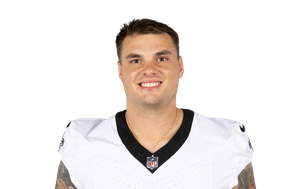
Shane
Lemieux.
 Oregon· 6'4"· 310 lb· 5.11s 40
"Fifty-two consecutive starts at one spot, and he finished all of them the same way: the most physical guard in the Pac-12 with the least margin for error athletically."Pre-draft read
Lemieux is a wide-bodied left guard whose game starts and ends with power. He plays from a low, heavy base, strikes with an aggressive first punch and drives through contact until the whistle, the anchor of a downhill Pac-12 front. Duo and gap runs are where he lives: he displaces defensive tackles with leverage rather than finesse.
The secondary trait is durability. He started every game of his college career at one spot, 52 straight, and never came off the field even when banged up. He is further along as a run blocker than as a pass protector, with an adequate anchor but heavy feet that show up against quicker interior rushers. The signature is finishing: the tape is full of defenders being pushed into the ground.
Gap and duo-based power rushing offense with play-action protection
Year 1 competitor for the starting left guard job in a downhill scheme; ceiling is a decade-long mauler at one interior spot
An outside-zone offense that asks guards to reach three-technique defenders and climb on the move, or a spread passing attack that leaves him isolated against quick interior rushers
Learning center later in his career was an attempt to add the flexibility the college tape never showed.
Shane Lemieux University of Oregon OG Highlights
College reel of the gap-scheme displacement and finishing that defined his Oregon tape.
Shane Lemieux Film Room
Pre-draft breakdown of his punch, base and limitations in space.
Giants OL Shane Lemieux Film Breakdown
Review of his rookie-year starts at left guard in New York.
Lemieux is a plug-and-play power guard with an iron-man resume. He started all 52 games of his Oregon career at left guard and logged 3,611 snaps there, including more than 900 in each of his last three seasons. He is not a scheme-flexible athlete; he is a specific answer for a specific offense, the kind of interior blocker who moves bodies on first and second down and lets the rest of the line work around him.
The production is well documented. As a junior he was the top-graded guard in the Pac-12 and the third-rated guard nationally by PFF. As a senior he was third in the conference, allowed one sack and three quarterback hits across 497 pass-blocking snaps, and finished second on the team with 51 knockdowns. He was a first-team All-American as a junior and second-team as a senior. The flags are athletic: 5.11 in the forty, 8.13 in the three-cone and a 4.90 shuttle, numbers that predict trouble reaching landmarks in wide zone and recovering against interior speed.
The board pegged him as a mid-round starter in a gap-heavy scheme, with the mileage as both the selling point and a quiet medical question. At 150 the Giants bought toughness and an immediate competitor for interior snaps, which is exactly the right price for that profile.
- 01
Point-of-attack power
Strikes with a heavy first punch and generates real displacement on duo and gap concepts, which is why Oregon ran behind him on short yardage.
- 02
Iron-man durability
Started all 52 games of his college career at left guard and played 3,611 snaps there, over 900 in each of his final three seasons.
- 03
Pass-protection production
Allowed just one sack and three quarterback hits on 497 pass-blocking snaps as a senior while facing Pac-12 interior rushers weekly.
- 04
Finishing temperament
Second on the team with 51 knockdowns as a senior, and teammates and coaches consistently named him the toughest player in the program.
- 05
Decorated resume
First-team All-American as a junior and second-team as a senior, the top-graded Pac-12 guard in 2018 and a repeat first-team all-conference pick.
- 01
Lateral quickness
A 4.90 shuttle and an 8.13 three-cone confirm the tape: he struggles to reach landmarks on wide zone and to redirect against inside counters.
- 02
Recovery speed
Once a quicker rusher wins the first step across his face, he lacks the foot speed to reset and is forced to grab.
- 03
Positional rigidity
A career-long left guard with no snaps at another spot, which narrows his path to a roster spot behind an established starter.
- 04
Mileage and medicals
Playing through injuries for four straight seasons built the toughness case but also left a long history of wear on the knees and ankles.
Relative Athletic Score (Kent Lee Platte) benchmarks combine/pro-day numbers against every measured prospect at the position since 1987. 10.00 is elite; 5.00 is average.
— — — positional median (p50)
- 40 yd
- 5.11sp50
- Vertical
- 25.5inp50
- Broad jump
- 107inp50
- Three-cone
- 8.13sp50
- Shuttle
- 4.90sp50
- Bench
- —rep
| Yr | Team | G |
|---|---|---|
| 2016 | Oregon | 12 |
| 2017 | Oregon | 13 |
| 2018 | Oregon | 13 |
| 2019 | Oregon | 14 |
| Career | — | 52 |
Redshirted 2015. Started all 52 career games at left guard, 3,611 snaps. First-team All-American in 2018, second-team in 2019; top-graded Pac-12 guard as a junior.
A dash means the figure is not published by a source we trust — never a zero we invented.
Heavy-handed gap-scheme guard whose value is displacement rather than range.
Powerful, durable interior starter who plays every snap at one spot and controls the line of scrimmage.
Powerful college guard whose foot speed and health limited him to a short run of starts.
Everything above is the pre-draft evaluation. This section is what actually happened — updated year over year.
The Giants got the rookie year they wanted and almost nothing after it. Lemieux played twelve games in 2020 with nine starts, mostly at left guard, and finished the season as the incumbent starter after replacing Will Hernandez. New York was confident enough in him to move on from veteran Kevin Zeitler that offseason. Then a patella tendon injury in his left knee, suffered at the start of the 2021 camp, ended his season after one game and required surgery. A knee issue put him back on injured reserve in 2022, where he again managed one game, and in 2023 he played four games with one start after learning center on his own. He signed with New Orleans in 2024, made the team off the practice squad and started four of his seven appearances at center before another injured reserve stint.
In hindsight the evaluation was right and the body was not. The player Oregon sent out was a legitimate NFL run blocker, and the nine rookie starts showed it, but he never strung together a healthy season after 2020. Twenty-five games and sixteen starts across five years is a poor return, yet the blame sits mostly on knees. Ironically, the durability that defined his college case was the thing that vanished.