Ross
Blacklock.
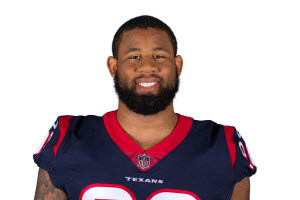
Ross
Blacklock.
 TCU· 6'3"· 290 lb· 4.90s 40
"The quickest interior first step in the class, delivered by a 21-year-old with two seasons of tape, a lost year in between, and no answer for what happens when the get-off fails."Pre-draft read
An explosive interior penetrator built to shoot gaps rather than hold them. At 6-3 and 290 pounds he fired off the ball with rare quickness for the position, splitting double teams before they formed and living in the backfield when he timed the snap correctly.
The upfield burst was the calling card and the ceiling. He converted speed to power and flashed a swim move that beat guards clean. The problems were leverage and consistency: he played high, got washed out of run fits, and his effort dipped when the first move was stoned. The signature was the first step, a get-off that drew comparisons to some of the best three-techniques in the league.
Attacking one-gap four-man front that turns him loose upfield as a three-technique and never asks him to hold a double team.
Year 1: rotational passing-down penetrator. Ceiling: an every-down three-technique with seven sacks and constant backfield disruption.
Two-gap 3-4 front that asks him to hold the point against down blocks and control two gaps at a time.
His entire value depends on a defense that lets him go forward on every snap.
TCU DT Ross Blacklock 2019 Highlights
The comeback season that made him a top-40 pick.
Ross Blacklock, DT TCU, 2020 NFL Draft Profile
Pre-draft breakdown of the get-off and the leverage problems.
Prospect Primer: Ross Blacklock
Scouting study of the one-gap projection at the next level.
Blacklock's college career was two seasons long and unusually eventful. He redshirted in 2016, then started all 14 games as a redshirt freshman in 2017 with 27 tackles, 6.5 for loss and two sacks, earning Freshman All-America honors from the Football Writers Association of America and Big 12 Co-Defensive Freshman of the Year.
Then he lost the entire 2018 season to an injury suffered in fall camp. He returned in 2019 and was better than before, starting all 12 games with 40 tackles, 9.0 tackles for loss and a team-leading 3.5 sacks, earning first-team All-Big 12 honors and honorable-mention Big 12 Defensive Lineman of the Year recognition.
The pre-draft appeal was straightforward: the quickest interior get-off in the class, delivered by a 21-year-old who had already lost a year and come back stronger. The concerns were the thin sample, the pad level, the run-defense inconsistency and the questions about maturity and focus that scouts kept circling back to. Houston, having lost nose tackle D.J. Reader in free agency, spent its first pick in the draft on a hometown player from Missouri City, twenty minutes from NRG Stadium, at 40th overall.
- 01
Explosive get-off
Fires out of his stance faster than almost any interior lineman in the class and beats guards before contact.
- 02
Gap penetration
Splits double teams before they can form and creates negative plays from the three-technique alignment.
- 03
Short-area power
Converts speed to force on contact, walking guards backward when he wins the first two steps cleanly.
- 04
Youth and recovery
Returned from a lost 2018 season better than before, posting career highs across the board in 2019.
- 05
Hand activity
Keeps his hands working through the rep with a swim move that beats interior blockers cleanly.
- 01
Pad level
Plays too tall for his size and surrenders leverage the moment his first step fails to create separation.
- 02
No run anchor
Gets washed out of run fits by combination blocks and cannot hold a gap when asked to two-gap.
- 03
Small sample
Only two seasons of college football, with a lost 2018, leaving little tape to confirm the traits.
- 04
Discipline
Flashes a temper that produces avoidable personal fouls and snaps where the effort visibly drops.
Relative Athletic Score (Kent Lee Platte) benchmarks combine/pro-day numbers against every measured prospect at the position since 1987. 10.00 is elite; 5.00 is average.
— — — positional median (p50)
- 40 yd
- 4.90sp50
- Vertical
- 29inp50
- Broad jump
- 107inp50
- Three-cone
- 7.77sp50
- Shuttle
- 4.67sp50
- Bench
- —rep
| Yr | Team | G | Tkl | Sk | Int | PD | FF |
|---|---|---|---|---|---|---|---|
| 2017 | TCU | 14 | 27 | 2 | 0 | 0 | 0 |
| 2019 | TCU | 12 | 40 | 3.5 | 0 | 0 | 0 |
| Career | — | 26 | 67 | 5.5 | 0 | 0 | 0 |
Both season lines are published by TCU athletics and the Texans draft release and include bowl games; they sum exactly to the two-season career totals shown. He redshirted in 2016 and missed all of 2018 after an injury in fall camp, so no rows appear for those years rather than phantom seasons of zeros. Pass breakups, forced fumbles and fumble recoveries are not published by season and are left blank instead of entered as zero.
A dash means the figure is not published by a source we trust — never a zero we invented.
A quick interior rusher who produces in a rotation without ever anchoring a run defense.
The ceiling: an explosive undersized three-technique whose get-off turns him into a perennial Pro Bowler.
The downside: a one-dimensional interior player who bounces between rosters as a situational body.
Everything above is the pre-draft evaluation. This section is what actually happened — updated year over year.
The NFL career never got traction. He played 11 games as a rookie in Houston with 14 tackles and no sacks, then 12 games in 2021 with 22 tackles and two sacks, which remains his best professional season. Houston traded him to Minnesota before the 2022 season and he appeared in just two games with the Vikings, recording two tackles and a sack. In 2023 he passed through Jacksonville, Indianapolis and Tennessee, playing two games for the Titans. He spent time on the Giants' offseason roster in 2024 and the Falcons' in 2026 without making a regular-season appearance.
The verdict is a clear bust, and the file predicted the mechanism precisely. Every concern listed before the draft, the pad level, the inability to anchor, the thin sample and the focus questions, is exactly what kept him off the field once the get-off alone stopped being enough. The burst was real, but a one-move interior rusher who cannot hold a gap has no role, and 40 career tackles from the eighth pick of round two is among the worst returns in this class.
Data note: from Arizona