Nate
Stanley.
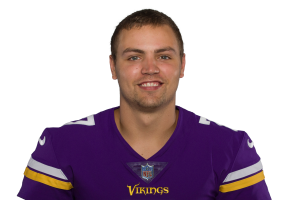
Nate
Stanley.
 Iowa· 6'4"· 235 lb· 4.81s 40
"Minnesota drafted Iowa's big, strong-armed pocket passer at No. 244, and he spent two seasons as a developmental backup on the Vikings' practice squad without ever appearing in a regular-season NFL game."Pre-draft read
Stanley was a pro-style quarterback in Iowa's under-center offense, a 6-4, 235-pound three-year starter who started 39 straight games. His primary trait was arm strength: he drove the ball to the boundary and vertically with velocity, throwing for 8,302 yards and 68 touchdowns in his career.
His secondary trait was toughness in the pocket, standing in against pressure in a run-first system with play-action concepts. His accuracy was uneven, completing 58.3 percent of his passes, and his mobility was limited. His signature was the steady winning of a three-year starter who went 27-12 with a 3-0 record in bowl games.
Under-center play-action offense that leans on the run and asks the quarterback to push the ball downfield.
Year 1: developmental third quarterback. Ceiling: backup quarterback in a play-action system.
Spread, quick-game offense that demands rhythm accuracy and off-script playmaking from the quarterback.
His arm and experience fit best in an under-center, play-action system.
2020 NFL Draft: Iowa Hawkeye QB Nate Stanley Highlights
His Iowa career before the draft.
The Best of Nate Stanley: 2018 Mid-Season Highlights | Iowa | Big Ten Football
His 2018 junior season.
Iowa QB Nate Stanley after final game at Kinnick
Postgame interview after his final home game.
Stanley projected as a big, strong-armed pocket passer whose inconsistent accuracy and limited mobility made him a late-round developmental backup. Evaluators liked his size, arm and experience in a pro-style offense, but questioned his touch, anticipation and ability to create outside the pocket.
He started 39 consecutive games for Iowa from 2017 through 2019, posting a 27-12 record and going 3-0 in bowl games. He threw for 2,437 yards and 26 touchdowns as a sophomore, 2,852 yards and 26 touchdowns as a junior, and 2,951 yards and 16 touchdowns as a senior. He finished second in school history in passing yards and touchdowns, with 8,302 yards, 68 touchdowns and 23 interceptions. The flags were his 58.3 completion rate, inconsistent footwork and limited mobility.
Most boards viewed him as a late-round or priority free agent quarterback. Minnesota took him at No. 244 as a developmental backup who fit its play-action offense. The Vikings valued his arm and under-center experience, hoping time on the practice squad could clean up his footwork and accuracy enough to make him a No. 3 quarterback.
- 01
Arm strength
Drove the ball to the boundary and down the field with velocity, throwing for 8,302 yards and 68 touchdowns at Iowa.
- 02
Experience
Started 39 consecutive games in a pro-style, under-center offense, arriving familiar with NFL play-action concepts.
- 03
Winning record
Went 27-12 as a starter with a 3-0 record in bowl games, managing games effectively within a run-first system.
- 04
Size and toughness
At 6-4 and 235 pounds he stood in against pressure and took hits while delivering throws downfield.
- 05
Ball security
Threw only 23 interceptions on 1,155 career attempts, protecting the football in Iowa's conservative system.
- 01
Inconsistent accuracy
Completed 58.3 percent of his career passes, missing too many throws in the short and intermediate game.
- 02
Limited mobility
Offered little as a runner or creator outside the pocket, making him vulnerable when protection broke down.
- 03
Anticipation
Often waited for receivers to come open instead of throwing on time, a habit that would be exposed in the NFL.
- 04
Declining production
His touchdown total fell from 26 to 16 as a senior, raising questions about his development curve.
Relative Athletic Score (Kent Lee Platte) benchmarks combine/pro-day numbers against every measured prospect at the position since 1987. 10.00 is elite; 5.00 is average.
— — — positional median (p50)
- 40 yd
- 4.81sp50
- Vertical
- 28.5inp50
- Broad jump
- 108inp50
- Three-cone
- 7.26sp50
- Shuttle
- 4.48sp50
- Bench
- —rep
| Yr | Team | G | Cmp | Att | Yds | TD | Int |
|---|---|---|---|---|---|---|---|
| 2016 | Iowa | 6 | 5 | 9 | 62 | 0 | 0 |
| 2017 | Iowa | 13 | 196 | 351 | 2437 | 26 | 6 |
| 2018 | Iowa | 13 | 235 | 396 | 2852 | 26 | 10 |
| 2019 | Iowa | 13 | 237 | 399 | 2951 | 16 | 7 |
| Career | — | 45 | 673 | 1155 | 8302 | 68 | 23 |
Season and career passing from Sports-Reference and StatMuse. Sources list 44 or 45 career games because of how the 2016 appearances are counted, and Sports-Reference's 45 is used. Rushing totals include sack yardage and are omitted.
A dash means the figure is not published by a source we trust — never a zero we invented.
The realized outcome: a developmental backup who never played in a game.
His Iowa predecessor, a pocket passer who carved out a long backup career.
Big Ten starter drafted late who was out of the NFL within a few years.
Everything above is the pre-draft evaluation. This section is what actually happened — updated year over year.
Stanley spent the 2020 season on Minnesota's practice squad and remained with the Vikings into 2021 before being released. He never appeared in a regular-season NFL game, and his professional career ended after his two seasons with Minnesota.
In hindsight the pick returned the minimal value common for a late seventh-round quarterback. The size, arm strength and pro-style experience that evaluators liked were enough to earn him a developmental spot, but the accuracy and mobility concerns flagged before the draft kept him from climbing the depth chart. His college legacy remains strong, with 39 straight starts, a 27-12 record, a 3-0 mark in bowl games and a place second in Iowa history in passing yards and touchdowns. At the NFL level he stayed a third-string developmental quarterback who never got a regular-season snap, and the gap between his college résumé and his pro outcome was wide.