
Laviska
Shenault.
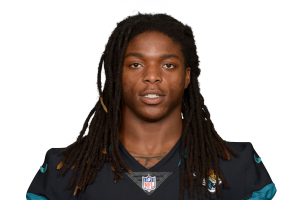
Laviska
Shenault.
 Colorado· 6'1"· 227 lb· 4.58s 40
"A 220-pound gadget weapon Colorado moved everywhere to survive: unblockable with the ball in his hands, undefined as a position, and always one hamstring away from the next missed month."Pre-draft read
Colorado's offense was built around getting him the ball however it could: jet sweeps, wildcat snaps, screens, slants and the occasional isolated go ball. He is a 220-pound receiver who runs like a big back after the catch, lowering his pads through the first tackler and steering through arm tackles with rare balance. Short-area burst off the catch point is the trait.
As a route runner he is still a project: he wins with size and physicality on slants and crossers, but the release package is limited and he rounds breaks against press-man. The blocking is genuine and the run-after-catch is the calling card, which is why the projection was a movable chess piece rather than an outside X who beats a corner on a full route tree.
A gadget-heavy offense that manufactures touches — jet motion, screens, wildcat snaps — rather than a route-tree passing game that asks its Z to win alone.
Year 1: 40-touch package player and returner. Ceiling: a 70-catch move piece who is the offense's leading yards-after-catch producer.
A timing passing game that lives on the boundary and needs its outside receivers to beat press-man off the line on a full tree.
The touches have to be scripted; nothing about his game creates volume on its own.
Laviska Shenault Ultimate Highlights
Full Colorado reel: the yards-after-catch power and the breadth of alignments the staff used to get him touches.
Laviska Shenault decimates UCLA
Single-game showcase of the contact balance and short-area burst that made him a top-45 pick.
Shenault is one of the hardest evaluations in the class because he was never allowed to be a wide receiver. Colorado, short on skill talent, used him at Z, in the slot, in the backfield and under center, and the tape is a highlight reel of a 220-pound athlete running through tackles rather than a receiver separating on a route tree.
The production was real when he was upright. He broke out as a sophomore in 2018 with 86 catches for 1,011 yards and six receiving touchdowns while adding 17 carries, 115 yards and five rushing scores, then slipped to 56 catches for 764 yards as a junior in 2019 as injuries and defensive attention piled up. He finished with 149 receptions for 1,943 yards and 10 receiving touchdowns plus 42 carries for 280 yards and seven rushing scores in 32 games. The availability flag was loud: core-muscle surgery after the season, a toe issue, a shoulder problem, plus hamstring and turf-toe absences that cost him games in each of his final two years.
Boards saw a top-40 athlete with a first-round trait and a fourth-round route resume, and the medical pushed him down. Jacksonville, looking for a physical complement to D. J. Chark, took him 42nd betting a real coordinator could organize the chaos.
- 01
Run after catch
220 pounds with contact balance and a low pad level; the first defensive back almost never brings him down in the open field.
- 02
Positional versatility
legitimate reps at Z, slot, wildcat quarterback and tailback, which gives a coordinator a package rather than a single alignment.
- 03
Short-area burst
snaps into top gear inside three steps on slants, screens and sweeps, which is what made the manufactured-touch game work at Colorado.
- 04
Contested strength
plays through contact at the catch point and finishes through hands-on coverage rather than folding when a corner gets into him.
- 05
Willing blocker
attacks perimeter run blocks with real intent and size, a rare and reliable trait for a second-round skill player.
- 01
Availability
core-muscle surgery, toe, shoulder and hamstring issues cost him games in both breakout seasons and the medical dropped him on boards.
- 02
Route tree
wins on slants, sweeps and crossers; the vertical and intermediate tree is undeveloped and breaks round off against press-man coverage.
- 03
Long speed
a 4.58 forty at the Combine confirms what the tape shows: he runs through defenders rather than away from them once he clears the level.
- 04
Scheme-dependent usage
the production came from designed touches, so a team that will not build a gadget package gets far less of the player.
Relative Athletic Score (Kent Lee Platte) benchmarks combine/pro-day numbers against every measured prospect at the position since 1987. 10.00 is elite; 5.00 is average.
— — — positional median (p50)
- 40 yd
- 4.58sp50
- Vertical
- —in
- Broad jump
- —in
- Three-cone
- —s
- Shuttle
- —s
- Bench
- 17repp50
| Yr | Team | G | Rec | Yds | TD |
|---|---|---|---|---|---|
| 2017 | Colorado | 12 | 7 | 168 | 0 |
| 2018 | Colorado | 9 | 86 | 1011 | 6 |
| 2019 | Colorado | 11 | 56 | 764 | 4 |
| Career | — | 32 | 149 | 1943 | 10 |
Season sums match the career line exactly on receptions, yards and touchdowns. Missed games in 2018 and 2019 to injury; return statistics are excluded here.
A dash means the figure is not published by a source we trust — never a zero we invented.
Gadget touches plus real return value, with a receiver role that never stabilizes.
The full realization: a coordinator builds a run-and-pass package around him and he becomes a scheme unto himself.
Athletic tools erased by an injury history and a role no staff can define.
Everything above is the pre-draft evaluation. This section is what actually happened — updated year over year.
Jacksonville got the manufactured-touch version and it worked twice. He caught 58 passes for 600 yards and five touchdowns as a rookie in 2020 and 63 for 619 in 2021, but never scored again through the air that second year and the offense around him changed staff twice. The Jaguars traded him to Carolina before 2022 for a 2023 seventh-rounder and a 2024 sixth; he caught 27 passes for 272 yards there, then just 10 for 60 yards in eight games in 2023. In 2024 he bounced through the Chargers and Seattle, where he reinvented himself on special teams, averaging 28.7 yards per kick return with a 97-yard touchdown against San Francisco. Buffalo signed him in March 2025 as a returner and released him at cutdowns that August; he did not play an NFL regular-season snap in 2025 and was on the Birmingham Stallions' UFL roster in March 2026.
The miss was in believing the gadget package would convert into a receiver's job. His NFL line — 63 games, 163 catches, 1,587 yards, six touchdowns — is essentially two decent seasons and then nothing, because when a staff asked him to win as a route runner on early downs the separation was not there. The evaluation of the trait was correct; the projection of the position was not.
Data note: Imported from Wikipedia 2020 NFL draft player selections table.