
Keith
Ismael.
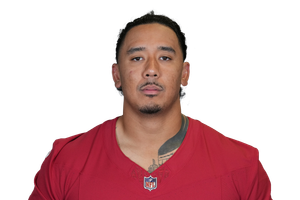
Keith
Ismael.
 San Diego St.· 6'3"· 309 lb· 5.34s 40
"The hands and the snap-to-snap intelligence are the reasons he started 38 college games; the balance is the reason no NFL line ever handed him the job."Pre-draft read
Ismael is a compact, technically clean interior lineman whose game is built on hands and leverage. He plays with a long torso and a low base, latches with big, strong hands inside the frame and steers the down defender where he wants him to go. San Diego State ran him from shotgun and under center and used him as the communicator on a line that changed pieces around him every year.
The second trait is movement. He is an explosive combo blocker who climbs cleanly to the second level and works in rhythm with his guards, which is why zone running teams liked him. Pass protection is more anchor than punch: he holds his ground against bull rushers, though he waist-bends and ends up on the ground more than a center should.
Outside and inside zone running scheme that asks the center to reach, climb and combo rather than drive block
Year 1 swing backup at center and guard; ceiling is a low-end starting zone center
A gap-scheme, downhill power offense that asks its center to displace a two-gapping nose tackle one-on-one
He snapped from both shotgun and under center in college, so the operational side was never the question.
Aztecs lineman a projected NFL Draft pick
Pre-draft feature on Ismael as San Diego State three-time all-conference center.
Keith Ismael Is Ready to Take His Game to the Next Level
Pre-draft interview covering his move from guard to center and his run-blocking identity.
The Profile Of Center Keith Ismael
Film-based breakdown of his hands, combo blocking and balance concerns.
Ismael is the kind of prospect Mountain West offensive lines produce every few years: a three-year starter with a long resume and no single elite trait. A two-star signee from Oakland, he redshirted in 2016 and then started 38 of the 39 games he played, 27 of them at center and 11 at guard, missing only one game with a concussion.
The honors were consistent. Second-team All-Mountain West as a redshirt freshman in 2017, first-team in both 2018 and 2019, Pro Football Focus third-team All-American as a junior, team offensive lineman of the year twice, and appearances on the Outland and Rimington watch lists. In 2019 he played 954 of San Diego State 956 offensive snaps at center. He declared a year early after finishing his degree in December.
Scouts liked the hands, the awareness against games and twists, and the guard-center flexibility that makes a backup valuable on game day. The reservations were balance, playing on the ground too often and a medical that kept him from bench pressing at the combine. That put him in the sixth-to-seventh round range on most boards; Washington took him a round earlier at 156 to add depth behind Chase Roullier.
- 01
Hands
Big, strong hands that latch inside the frame and steer defenders, the single trait that showed up on every scouting report of his tape.
- 02
Combo blocking
Explosive off the snap and smooth working double teams to the second level, which made him a natural fit in a zone running scheme.
- 03
Versatility
Started 27 games at center and 11 at guard, the three-position flexibility that keeps a backup on a game-day roster.
- 04
Awareness
Identified games and twists up front, worked to find work when uncovered, and ran the line calls for three different quarterbacks.
- 05
Durability and production
Started 38 of 39 games across three seasons and played 954 of 956 offensive snaps in 2019 while earning first-team all-conference honors.
- 01
Balance
He is on the ground more than a center should be, losing blocks he had already won because his feet stop when the defender counters.
- 02
Waist bending
Bends at the waist instead of sinking and sliding his feet, which lets rushers work across his face on the second effort.
- 03
Anchor at the point
Holds up against average power but can be walked back by heavy nose tackles, a problem the NFL exposed immediately.
- 04
Medical questions
Shoulder surgery cost him the 2019 spring and he did not bench press at the combine, which pushed him down boards.
Relative Athletic Score (Kent Lee Platte) benchmarks combine/pro-day numbers against every measured prospect at the position since 1987. 10.00 is elite; 5.00 is average.
— — — positional median (p50)
- 40 yd
- 5.34sp50
- Vertical
- 32inp50
- Broad jump
- 108inp50
- Three-cone
- 8.14sp50
- Shuttle
- 4.65sp50
- Bench
- —rep
| Yr | Team | G |
|---|---|---|
| 2017 | San Diego State | 13 |
| 2018 | San Diego State | 13 |
| 2019 | San Diego State | 13 |
| Career | — | 39 |
Redshirted 2016. Career totals of 39 games and 38 starts are confirmed by San Diego State and national reporting; 27 starts came at center and 11 at guard. Offensive linemen do not carry box-score statistics, so no other cells are populated.
A dash means the figure is not published by a source we trust — never a zero we invented.
Decorated college center whose balance and anchor limited him to backup snaps.
Technically sound zone center who turned versatility and awareness into a long starting career.
Interior lineman who never stuck beyond practice squads.
Everything above is the pre-draft evaluation. This section is what actually happened — updated year over year.
Ismael never became the starter Washington hoped for. He dressed for eight games as a rookie without a start, then in 2021 bounced on and off the practice squad four separate times before getting five starts late in the year when injuries hit the interior. Washington tendered him in 2022 as an exclusive rights free agent, put him on injured reserve in August and released him with an injury settlement after a concussion. San Francisco added him to the practice squad, kept him through 2022, and waived him in August 2023, at which point Arizona claimed him. He played 13 games for the Cardinals in 2023 without a start, re-signed for 2024 and was released that August.
The verdict is a fifth-round backup who did the job for four seasons and never more. Thirty-one games and five starts is roughly the median outcome for an interior lineman taken in that range, and the flags scouts wrote down held up: the balance issues and the lack of a functional pass-protection punch kept him from taking a job when the chances came. He was a reliable emergency snapper, not a starter.