
Joshua
Kelley.
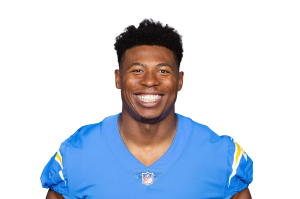
Joshua
Kelley.
 UCLA· 5'11"· 212 lb· 4.49s 40
"A two-year UCLA workhorse and former walk-on with back-to-back 1,000-yard seasons whose toughness was never in question and whose burst always was."Pre-draft read
Kelley is a compact, thickly built one-cut runner who plays with pace and contact balance rather than elusiveness. He presses the line hard, reads his blocks in a straight line and gets downhill in a hurry, bouncing off arm tackles and falling forward on nearly every carry.
His best trait is durability of style: he takes a heavy workload and keeps churning through contact late in games, which is how he produced back-to-back 1,000-yard seasons. He is a willing pass protector who squares up blitzers. What he lacks is a gear and a jump cut — he does not make defenders miss in the hole, and long runs come from clean lanes rather than creativity. The signature is toughness and consistency, not explosiveness.
A zone or gap run scheme that gives him defined creases on early downs and values a back who protects the quarterback on third down.
Year 1 complementary early-down back and pass protector, with a ceiling as a committee starter who handles 200 carries for a run-first offense.
A spread offense that asks its back to create in space, win one-on-one in the screen game or threaten defenses with breakaway speed.
Joshua Kelley 2019 UCLA Highlights
Full senior-season cutup from his second straight 1,000-yard year.
Joshua Kelley UCLA 2018 Highlights
Breakout season reel including the 289-yard game against USC.
UCLA upsets No. 24 Arizona State behind 4 Joshua Kelley touchdowns
Four-touchdown performance that was the signature game of his final year.
Kelley took the long road. He lettered two years at UC Davis, transferred to UCLA in 2017 and walked on, then became the centerpiece of the Bruins' offense for two seasons. As a redshirt junior in 2018 he played eleven games with nine starts and ran for 1,243 yards, the tenth-most in school history, with six 100-yard games including a 289-yard performance against USC that was the most ever in the rivalry game.
His final year was just as productive. He started all eleven games he played, ran for 1,060 yards and scored thirteen touchdowns, becoming only the eighth running back in UCLA history with back-to-back 1,000-yard seasons. He finished second in the Pac-12 in rushing yards per game at 96.4, earned first-team all-conference honors from the Associated Press, was a Burlsworth Trophy semifinalist as the nation's best former walk-on and took home UCLA's team MVP award. He left ranked 14th on the school's all-time rushing list with 2,303 yards.
The board saw a productive, sturdy back with pedestrian athletic testing and no home-run gear. Nobody doubted the toughness or the pass protection, but the scouting question was whether a back without elusiveness or top-end speed could earn carries against NFL defenses. The Chargers, needing depth behind Austin Ekeler, took him at 112.
- 01
Back-to-back 1,000-yard seasons
Only the eighth running back in UCLA history to do it, with 2,303 rushing yards in two years.
- 02
Contact balance
Bounces off arm tackles and consistently falls forward, converting would-be short gains into first downs.
- 03
Pass protection willingness
Squares up blitzers instead of chipping and sliding, a real third-down argument for a rookie back.
- 04
Heavy-workload durability
Carried the offense as a featured back for two seasons without his production fading late in games.
- 05
Signature performances
Ran for 289 yards against USC, the most in the history of that rivalry game, and scored four touchdowns against Arizona State.
- 01
No home-run speed
Long runs come from clean lanes rather than pulling away, and he rarely outruns angles at the second level.
- 02
Limited elusiveness
Lacks a jump cut in the hole and does not make defenders miss in confined space or in the open field.
- 03
Late bloomer profile
Two years at UC Davis and a walk-on transfer year meant only two seasons of Power Five tape.
- 04
Ball security concerns
Runs so aggressively through contact that the ball drifts from his body, and fumbles followed him to the NFL.
Relative Athletic Score (Kent Lee Platte) benchmarks combine/pro-day numbers against every measured prospect at the position since 1987. 10.00 is elite; 5.00 is average.
— — — positional median (p50)
- 40 yd
- 4.49sp50
- Vertical
- 31inp50
- Broad jump
- 121inp50
- Three-cone
- 6.95sp50
- Shuttle
- 4.28sp50
- Bench
- 23repp50
| Yr | Team | G | Att | Yds | TD | Rec | RecYds |
|---|---|---|---|---|---|---|---|
| 2018 | UCLA | 11 | 0 | 1243 | 0 | 0 | 0 |
| 2019 | UCLA | 11 | 0 | 1060 | 0 | 0 | 0 |
| Career | — | 22 | 0 | 2303 | 0 | 0 | 0 |
Only his two UCLA seasons are itemized here; official releases confirm 1,243 rushing yards in 2018 and 1,060 in 2019, which sum exactly to his published UCLA career total of 2,303. Carry totals, receptions and per-season touchdown splits are not broken out in the sources consulted and are left empty rather than estimated, though UCLA credits him with thirteen total touchdowns in 2019 and 25 in his Bruin career. He also lettered two seasons at UC Davis before transferring, which is not included in these totals.
A dash means the figure is not published by a source we trust — never a zero we invented.
A tough, straight-line runner who holds committee value for years without ever separating from the field.
The ceiling: a downhill back who hits 1,000 yards in a season when the offensive line gives him clean creases.
A productive college back who bounces between rosters and practice squads as a depth body.
Everything above is the pre-draft evaluation. This section is what actually happened — updated year over year.
He was a rotational back for four years and never more. Kelley got real rookie volume in Los Angeles in 2020, touching the ball 111 times for 354 yards and two scores while adding 23 catches, but the 3.2 yards per carry told the story and he lost two fumbles. His role shrank to 33 carries in 2021, rebounded modestly to 69 carries at 4.2 yards a pop in 2022, and peaked again in 2023 with 107 attempts for 405 yards behind Austin Ekeler.
Free agency was unkind. The Giants signed him in August 2024 and released him ten days later, Tennessee added him to the practice squad in October, and he finished the year with a single carry for two yards. He became a free agent again in March 2025. The career line reads 57 games, 321 carries, 1,150 yards at 3.6 per attempt, six rushing touchdowns and 50 receptions. In hindsight the pre-draft concern was exactly right: without a burst or a jump cut, a tough runner is a backup, and the fourth round was a steep price for four years of committee work.