
Darnell
Mooney.
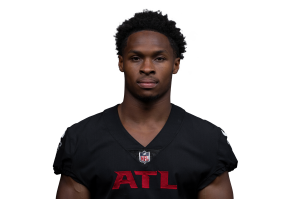
Darnell
Mooney.
 Tulane· 5'10"· 176 lb· 4.38s 40
"Speed is the headline, but the reason Mooney lasts is that he can run a route tree at 4.38 without ever needing the ball placed perfectly."Pre-draft read
A four-year starter who lined up at the Z and in the slot at Tulane, Mooney is a vertical accelerator whose game begins with a flat, urgent release and top-end speed that shows by the third stride. He stems corners, attacks the outside shoulder, and gets on top of coverage in a hurry, then tracks and adjusts to the deep ball with soft hands away from his frame.
The second layer is route detail. He sinks his hips on comebacks and digs and throttles down intelligently against zone, which is why Tulane used him on third down rather than only on shot plays. He is a willing perimeter blocker despite a slight frame, though the run game is not where he wins. The signature is takeoff speed married to ball tracking.
Vertical spread passing offense with play-action shots
Year 1 field-stretching third receiver who clears space underneath; ceiling is a volume-capable WR2 who wins on speed and route tempo.
A condensed, contested-catch offense that asks its perimeter receivers to win at the catch point against press-man corners on isolation routes.
Best deployed off the line with a free release so press corners cannot reroute a 176-pound frame.
Tulane WR Darnell Mooney Highlights
Full college reel showing the vertical release package and deep-ball tracking.
Darnell Mooney | Tulane Green Wave | 2019 Highlights
Senior-season cutup with the comeback and dig detail against bracket coverage.
Darnell Mooney 2021 season highlights
His 1,055-yard NFL breakout season in Chicago.
Mooney is an undersized field-stretcher with real route nuance, a four-year Tulane starter who made 41 consecutive starts and left New Orleans sixth in program history in receiving yards. The identity is speed: a 4.38 forty at the Combine, fifth-fastest in the 2020 class, paired with a 1.44 ten-yard split that explains why cornerbacks were losing the leverage battle before he reached the stem.
Production backed the traits. He went 24-267-2 as a freshman, 34-599-4 as a sophomore, then broke out in 2018 with 48 catches for 993 yards, eight scores and a 20.7-yard average that led the American. His senior year drew bracket coverage and quarterback turnover, and the line settled at 48-713-5. The flags were obvious: 176 pounds, nine bench reps, short arms, and a contested-catch profile that shrank against physical press corners who could reroute him at the line.
Boards had him as a Day 3 speed specialist, generally a fifth-to-sixth-round grade with a return-game sweetener. Chicago liked him enough to trade up, sending picks 196, 200 and 233 to Philadelphia for 173 and 227. At that cost, the bet was simple: take the fastest reliable hands left on the board and let the vertical element sort itself out.
- 01
Long speed
a 4.38 forty with a 1.44 ten-yard split gave him true separation gear, and it was functional speed that showed on tape rather than a track-only number.
- 02
Ball tracking
he located the deep ball over either shoulder without decelerating, which is why his 2018 season produced a conference-best 20.7 yards per catch.
- 03
Release package
flat, low-pad releases with hand usage let him beat press despite a slight frame, and he rarely allowed a corner to reroute him cleanly.
- 04
Route detail beyond speed
he sank his hips on comebacks and digs and throttled down against zone, so defenses could not sit on the vertical stem alone.
- 05
Availability and toughness
41 consecutive starts and a captaincy in his final year, with a willingness to block on the perimeter that belied his listed weight.
- 01
Play strength
at 176 pounds with nine bench reps, physical corners could disrupt his timing at the line and ride him off his track down the field.
- 02
Contested catch volume
he thrived with separation but won few jump-ball reps, and his catch radius shrank against corners who matched his speed.
- 03
Frame and durability questions
evaluators worried the slender build would not hold up to an NFL slot workload across a full professional season.
- 04
Competition and scheme context
the American Athletic tape featured lighter secondaries, and Tulane's run-first offense limited his route-tree volume.
Relative Athletic Score (Kent Lee Platte) benchmarks combine/pro-day numbers against every measured prospect at the position since 1987. 10.00 is elite; 5.00 is average.
— — — positional median (p50)
- 40 yd
- 4.38sp50
- Vertical
- 37inp50
- Broad jump
- 124inp50
- Three-cone
- —s
- Shuttle
- —s
- Bench
- 9repp50
| Yr | Team | G | Rec | Yds | TD |
|---|---|---|---|---|---|
| 2016 | Tulane | 12 | 24 | 267 | 2 |
| 2017 | Tulane | 12 | 34 | 599 | 4 |
| 2018 | Tulane | 13 | 48 | 993 | 8 |
| 2019 | Tulane | 13 | 48 | 713 | 5 |
| Career | — | 50 | 154 | 2572 | 19 |
Season totals per Sports-Reference; the sum of the four seasons matches the 154-2,572-19 career line. Per-season starts were not published and are left null.
A dash means the figure is not published by a source we trust — never a zero we invented.
Undersized vertical threat with route detail who outgrows a specialist label.
Field-stretching starter whose long speed and tracking keep him productive for a decade.
One-note deep runner whose weekly value swings with shot-play volume.
Everything above is the pre-draft evaluation. This section is what actually happened — updated year over year.
Chicago got an immediate contributor. Mooney played all 16 games as a rookie and caught 61 balls for 631 yards and four scores, then broke out in 2021 with 81 receptions for 1,055 yards and four touchdowns across 17 games, the only 1,000-yard season of his career to date. Quarterback instability caught up with him after that: 40-493-2 in 12 games in 2022 and 31-414-1 in 2023 as Chicago rebuilt the room around him. He signed with Atlanta in 2024 and immediately posted 64 catches for 992 yards and five touchdowns, his best all-around season, before a quieter 32-443-1 line in 2025. He opened 2026 with the Giants.
In hindsight this is one of the better value picks of the fifth round. Mooney has played 93 games with 313 receptions for 4,103 yards and 17 touchdowns, numbers that clear almost every receiver taken behind him in 2020 and several taken well ahead. The size concerns were real but never disqualifying; what evaluators underrated was that his speed was paired with enough route craft to survive a role change from vertical specialist to primary target. Chicago's trade up cost three late picks and returned a starting receiver for four years.