
Damien
Lewis.
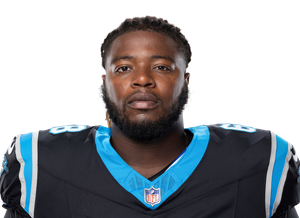
Damien
Lewis.
 LSU· 6'2"· 327 lb· 5.24s 40
"A two-time junior college All-American who started all 28 games at LSU's right guard on a national championship line, offering rare lower-body power and an anchor that no interior rusher walked back."Pre-draft read
Lewis is a power guard in the oldest sense of the term. He plays with a wide, heavy base, generates real displacement on down blocks and double teams, and finishes defenders into the ground when he gets his hands inside. In the run game he is at his best moving a tackle off the spot on a straight track rather than reaching a shade.
In protection the anchor is the selling point. Interior rushers do not walk him back once he sets: the lower-body strength is rare and he absorbs bull rushes without giving ground. The limitations are lateral: he is a short-area mover who can be beaten by quickness to either side, and he is not a puller who arrives on time in space. He wins where the collision happens, not where the footrace does.
Gap and power run scheme with a downhill identity, paired with a quarterback who wants a firm pocket in front of him rather than movement.
Year 1 starting guard in a power run game, with a ceiling as a decade-long anchor at the position who never needs replacing.
A wide-zone offense that asks the guard to reach-block a shade, pull across the formation and climb on the move every snap, where his lateral limitations become the play.
His floor is unusually high for a third-round lineman because the traits that made him good in college, strength and durability, are the traits that age best.
Damien Lewis, Senior Bowl Highlights
One-on-one and team reps in Mobile against other draftable interior defenders, the cleanest evaluation setting available.
Road to the Pros: Damien Lewis
Program-produced feature with game footage from the 2019 national championship season.
Damien Lewis Anchoring
Technique-focused breakdown of the anchor and hand usage that define his pass protection.
Lewis took the junior college route, starting all 22 games at Northwest Mississippi Community College and earning junior college All-America honors twice before enrolling early at LSU in 2018. He walked into the starting right guard job in his first game and never left it, starting all 28 games of his two-year LSU career and leading every Tiger lineman in snaps as a junior with 978.
His senior season was the best possible backdrop. He blocked for Joe Burrow's Heisman campaign and Clyde Edwards-Helaire's 1,000-yard season on a national championship team, earning first-team All-America recognition and second-team All-SEC. LSU's staff called him the strongest player on the roster, with a 635-pound squat, and the tape backed it: a mauler in a conference full of them.
The evaluation was unusually clean. Teams knew exactly what he was, because he had done the same thing at the same position for two seasons against the best interior defensive linemen in the country. The questions were about athletic range rather than ability. He ran 5.24 with 27 bench reps at 327 pounds, and the short-area agility drills he did not run were the ones that would have exposed him. A team looking for a plug-and-play power guard took him at the top of the third round.
- 01
Lower-body power
Elite functional strength that shows up on every down block and double team, with the ability to root out a nose tackle by himself.
- 02
Pass-protection anchor
Sets and holds against bull rushers without conceding depth, which is the single most valuable trait a guard can bring to a pocket.
- 03
Hand strength and placement
Once he gets inside leverage the rep is over, and defenders rarely disengage to make the play after he latches on.
- 04
Proven durability
Started all 28 games at LSU after starting all 22 in junior college, never missing a start at the same position across four seasons.
- 05
Competition level
Two years of SEC interior defensive linemen and a national championship run, which leaves very little projection about the level of play.
- 01
Lateral quickness
Struggles to redirect against interior rushers who attack his edges, and can be beaten by a quick swim before his hands arrive.
- 02
Movement in space
Not a natural puller or screen blocker, arriving late and off balance when the scheme asks him to get to the second level on the move.
- 03
Scheme range
Best in gap and power concepts, with limited evidence he can reach-block a shaded defender in a wide-zone run game.
- 04
Pad level consistency
Plays tall on occasion for a shorter lineman, which surrenders the leverage advantage his build should give him on contact.
Relative Athletic Score (Kent Lee Platte) benchmarks combine/pro-day numbers against every measured prospect at the position since 1987. 10.00 is elite; 5.00 is average.
— — — positional median (p50)
- 40 yd
- 5.24sp50
- Vertical
- 30inp50
- Broad jump
- 108inp50
- Three-cone
- —s
- Shuttle
- —s
- Bench
- 27repp50
| Yr | Team | G |
|---|---|---|
| 2018 | LSU | 13 |
| 2019 | LSU | 15 |
| Career | — | 28 |
Offensive linemen do not carry statistical lines, so only games and starts are recorded. LSU confirms he started all 28 games of his two-year career at right guard and led all Tiger linemen in snaps as a junior with 978. His two junior college seasons at Northwest Mississippi Community College (22 starts) are not included in these totals.
A dash means the figure is not published by a source we trust — never a zero we invented.
Durable power guard who starts for a decade in a gap scheme and does his best work moving bodies rather than in space.
The ceiling version, where elite power and an immovable anchor turn a mauler into a perennial Pro Bowl guard.
Strong interior lineman who ends up as a scheme-dependent starter and swing piece rather than a fixture at one spot.
Everything above is the pre-draft evaluation. This section is what actually happened — updated year over year.
Seattle got an immediate starter and has never had to think about the position since. Lewis started all 16 games as a rookie in 2020 and held the job for four seasons, playing 13 games in 2021 and a full 16 in both 2022 and 2023 while moving between right and left guard as the Seahawks reshuffled their line. He signed with Carolina in free agency in March 2024 and started all 16 games he appeared in each of his first two seasons there, becoming one of the anchors of the interior line that supported the Panthers' run game.
In hindsight this is close to a perfect third-round outcome. Lewis has started all 94 games he has played across seven seasons and two franchises, which is the rarest thing an offensive lineman can offer. He was never a Pro Bowl player, and the lateral limitations the evaluation flagged still show up against quick interior rushers, but nothing about the pick required a projection that did not come true. Teams draft guards in the third round hoping for a starter who never needs replacing, and that is exactly what this was.
Data note: from Carolina