
Colby
Parkinson.
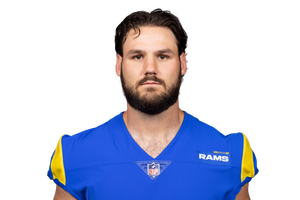
Colby
Parkinson.
 Stanford· 6'7"· 252 lb· 4.77s 40
"A 6-7 red-zone problem who tied a Stanford single-game record with four touchdown catches — all catch radius and box-out strength, with the separation speed left out of the package."Pre-draft read
Parkinson is a 6-7, 251-pound tight end who plays the position the way a basketball power forward plays the low post. He wins above the rim, boxes out defenders on contested throws and turns any ball near the back pylon into a fifty-fifty he usually wins.
Stanford used him as an in-line Y and as a flexed target, and his best football came on third down and in the red zone, where his catch radius makes a small window big. He is a smooth strider rather than a burner, and he covers ground with length instead of quickness. The speed is what caps him. He does not separate on the vertical stem, and at that height his pad level and leverage as a blocker are a work in progress. The signature is the strike zone.
A play-action offense that uses two tight ends and can flex the bigger one into the slot to attack the seam and the back pylon.
Year 1 second tight end and red-zone package specialist, with a ceiling as a starting Y who scores eight or more touchdowns in a season once the blocking catches up.
A spread offense that asks its lone tight end to win with speed on vertical routes and to block in space on perimeter runs.
Stanford's Colby Parkinson garners Pac-12 Football Offensive Player of the Week honors
Conference feature on the four-touchdown game against Oregon State that tied a school record.
Colby Parkinson is 6-foot-7 standout tight end
Profile of the size and catch radius that defined his college evaluation.
Parkinson was a matchup problem at Stanford before he was a complete tight end, and the three years of production track that exactly. He arrived as a freshman in 2017 and caught ten passes for 97 yards with four touchdowns in fourteen games, an absurd conversion rate for a first-year player barely on the field.
The sophomore year is the one that put him on the map. He played thirteen games with nine starts and finished with 29 catches for 485 yards and seven touchdowns, third-most among all tight ends in the country, and he tied the single-game school record with four touchdown catches against Oregon State on a six-catch, 166-yard afternoon that stands as the second-most receiving yards ever in a game by a Stanford tight end. As a junior he became the offense rather than the finisher: 48 receptions for 589 yards across twelve starts, second-team All-Pac-12 and a Mackey Award semifinalist, with only one touchdown as the Cardinal offense fell apart around him. He also threw an eight-yard touchdown pass at Oregon State.
The board split him on athleticism. The size and the hands were rare; the timed speed and the blocking were not there yet. He graded as a red-zone weapon who needed development in line. Seattle took him at 133.
- 01
Extraordinary catch radius
At 6-7 with long arms, he turns badly placed throws into completions and makes the strike zone enormous for his quarterback.
- 02
Red-zone production
Eleven touchdowns in his first two seasons on limited volume, including four in a single game against Oregon State to tie a school record.
- 03
Contested-catch strength
Boxes defenders out like a post player and wins jump balls rather than simply running under them.
- 04
Route diversity in the scheme
Stanford used him in line and flexed, and he understood coverage well enough to find the soft spot against zone.
- 05
Football character
A Pac-12 all-academic selection and civil engineering major whose preparation drew consistent praise from the Stanford staff.
- 01
Lack of separation
A long strider without the burst to create space on vertical stems, so most of his production comes on contested throws.
- 02
Blocking leverage
At 6-7 he plays high and loses ground against defensive ends, which limited his early-down snaps as a run blocker.
- 03
Marginal production spike
Only one touchdown as a junior, and the volume increase came with a drop in explosiveness per catch.
- 04
Play strength at the point
Needed weight and functional strength to hold up in line, which is the gap between a slot mismatch and a complete tight end.
Relative Athletic Score (Kent Lee Platte) benchmarks combine/pro-day numbers against every measured prospect at the position since 1987. 10.00 is elite; 5.00 is average.
— — — positional median (p50)
- 40 yd
- 4.77sp50
- Vertical
- 32.5inp50
- Broad jump
- 109inp50
- Three-cone
- 7.15sp50
- Shuttle
- 4.46sp50
- Bench
- 18repp50
| Yr | Team | G | Rec | Yds | TD |
|---|---|---|---|---|---|
| 2017 | Stanford | 14 | 10 | 97 | 4 |
| 2018 | Stanford | 13 | 29 | 485 | 7 |
| 2019 | Stanford | 12 | 48 | 589 | 1 |
| Career | — | 39 | 87 | 1171 | 12 |
Season lines come from the Stanford athletics player bio. Career totals are the sum of the three seasons. His 2017 start count was not published and is left empty, so the career start total is also left empty. He additionally threw one touchdown pass, an eight-yard strike at Oregon State in 2019.
A dash means the figure is not published by a source we trust — never a zero we invented.
A rotational second tight end who produces in bursts and moves between teams on modest contracts.
The ceiling: an oversized receiving tight end who becomes a genuine starter and a red-zone weapon without ever blocking well.
A big-bodied college producer whose lack of speed and blocking keeps him off the field and out of the league early.
Everything above is the pre-draft evaluation. This section is what actually happened — updated year over year.
Parkinson's career is a slow build that paid off in year six. He opened his rookie season on the non-football injury list with a foot problem, played six games with two catches, then lost the start of 2021 to injured reserve and finished with five catches in fourteen games. He became a real rotation piece in Seattle with 25 catches for 322 yards and two touchdowns in 2022 and 25 more for 247 and two scores in 2023, mostly as the second or third tight end.
The Rams signed him in free agency in 2024 and he took thirty catches for 294 yards with nine starts. Then 2025 happened: 43 receptions for 408 yards and eight touchdowns, a Rams single-season franchise record for receiving touchdowns by a tight end, including six in a six-game stretch from Weeks 10 through 15. He entered 2026 as a starter. In hindsight the evaluation named the right player and missed the timeline. The red-zone size that made him special at Stanford is exactly what made him a record-setter at 27, and everything in between was the blocking and strength development the scouting reports flagged.