
Clyde
Edwards-Helaire.
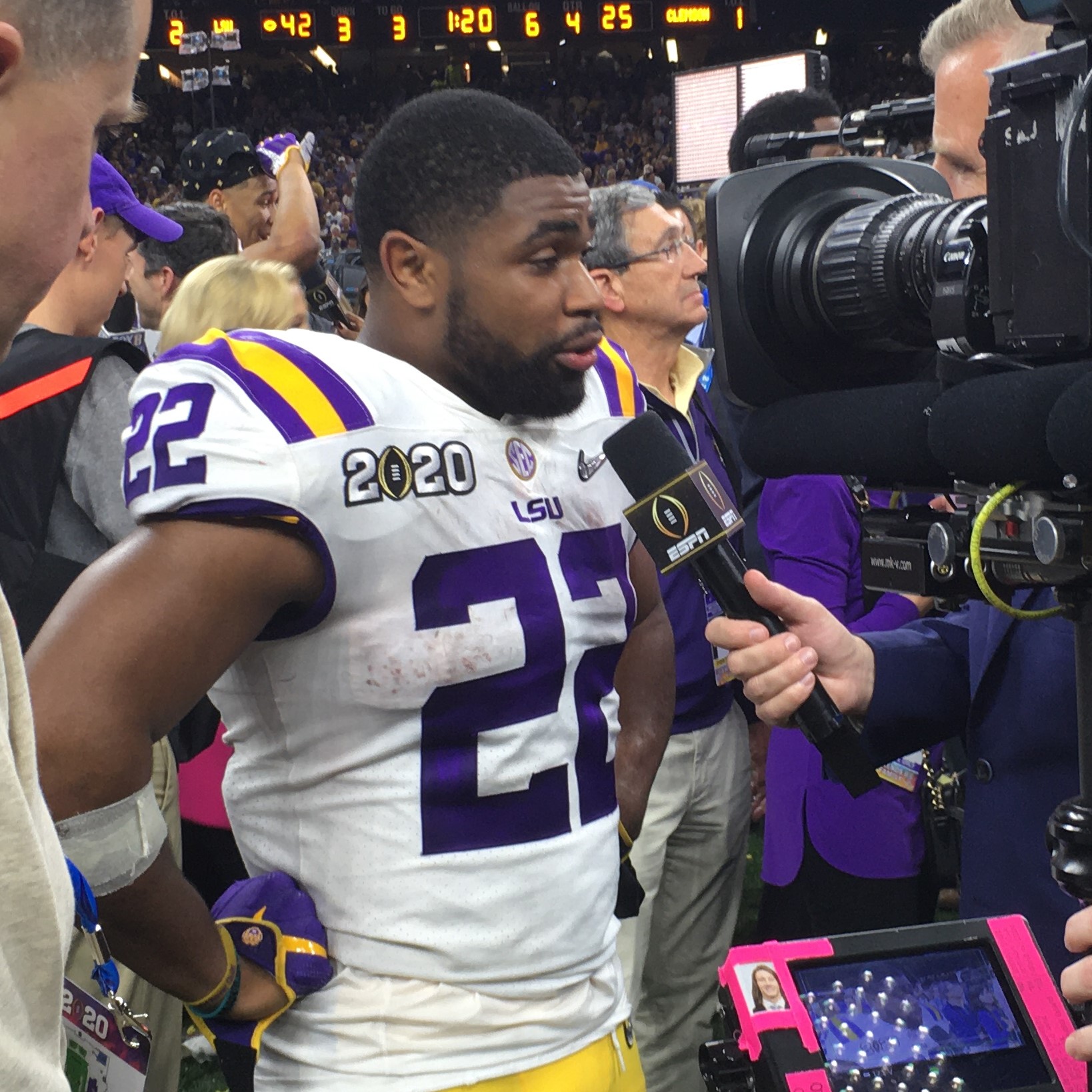
Clyde
Edwards-Helaire.
 LSU· 5'7"· 207 lb· 4.60s 40
"The most complete pass-catching back in the class coming off a 1,414-yard national championship season, and the exact profile the modern draft market says never to take in round one."Pre-draft read
Compact, low-center-of-gravity back who disappeared behind his linemen and reappeared in the secondary. At 5-8 and 207 pounds he had exceptional contact balance, changed direction without gearing down and forced missed tackles in tight spaces that taller backs never find.
The receiving work was the separator. He ran real routes out of the backfield, caught 55 passes as a junior and was a natural mismatch against linebackers in space. In the run game he pressed the hole with patience and accelerated through the crease, finishing runs through arm tackles. The limits were the frame and the long speed: he was not going to run away from NFL safeties or carry a heavy early-down workload against loaded boxes.
Spread passing offense that uses the back as a receiver, with zone runs out of eleven personnel and few obligations in short-yardage power.
Year 1: sub-package receiving back with 12-15 touches. Ceiling: a 1,400-yard-from-scrimmage centerpiece in a spread attack.
Downhill gap-scheme offense that wants him between the tackles twenty times a game behind a heavy front.
Andy Reid's offense was the ideal landing spot, which makes the outcome that much harder to explain away.
LSU RB Clyde Edwards-Helaire 2019 Highlights
The national championship season that produced the first-round grade.
Clyde Edwards-Helaire: Elusive, LSU Highlights 2019
Contact balance and change of direction in tight spaces.
2020 Film Breakdown: Clyde Edwards-Helaire
Pre-draft breakdown of the vision, receiving work and size questions.
Edwards-Helaire arrived in the 2020 class off one of the best seasons a running back has had at LSU. Playing in the national championship offense with Joe Burrow, he rushed for 1,414 yards and 16 touchdowns and caught 55 passes for 453 yards, the most receptions by a running back in school history, and earned first-team All-SEC honors.
The backstory was patience. He was a rotational piece as a freshman, finished second on the team with 658 rushing yards and seven touchdowns as a sophomore while averaging 24.5 yards on kickoff returns, and only became the feature back as a junior. Across 41 games he rushed for 2,158 yards on 370 carries with 23 touchdowns and added 69 receptions.
The evaluation split on how the profile translated. Supporters saw the most complete pass-catching back in the class, a plug-and-play third-down weapon with contact balance and route polish who would thrive in a spread offense. Skeptics saw a 5-8 back with limited long speed in a positional market that had collapsed, and argued the first round was too rich. Kansas City, coming off a Super Bowl and looking for an Andy Reid satellite back, took him 32nd overall, the only running back drafted in round one.
- 01
Receiving ability
Caught 55 passes as a junior, a school record for a running back, running real routes rather than checkdowns.
- 02
Contact balance
Bounces off arm tackles and stays upright through contact, running far harder than a 207-pound frame suggests.
- 03
Vision and patience
Presses the hole, lets blocks develop and accelerates through the crease without wasted steps.
- 04
Elusiveness in space
Changes direction without gearing down and forces missed tackles in phone-booth situations.
- 05
Return value
Averaged 24.5 yards on 17 kickoff returns as a sophomore, ranking fifth in the SEC in that phase.
- 01
Long speed
Gets caught from behind once he clears the second level and will not outrun NFL safeties to the pylon.
- 02
Size and workload
At 5-8 and 207 pounds he is not built to absorb twenty-plus carries a week against loaded boxes.
- 03
Single-season sample
One year as a feature back, with a modest role behind others across his first two college seasons.
- 04
Positional value
A running back with no pass-protection dominance taken in a round where the market rarely rewards the position.
Relative Athletic Score (Kent Lee Platte) benchmarks combine/pro-day numbers against every measured prospect at the position since 1987. 10.00 is elite; 5.00 is average.
— — — positional median (p50)
- 40 yd
- 4.60sp50
- Vertical
- 39.5inp50
- Broad jump
- 123inp50
- Three-cone
- —s
- Shuttle
- —s
- Bench
- 15repp50
| Yr | Team | G | Att | Yds | TD | Rec | RecYds |
|---|---|---|---|---|---|---|---|
| 2017 | LSU | 13 | 0 | 31 | 0 | 3 | 46 |
| 2018 | LSU | 13 | 0 | 658 | 7 | 11 | 96 |
| 2019 | LSU | 15 | 215 | 1414 | 16 | 55 | 453 |
| Career | — | 41 | 370 | 2158 | 23 | 69 | 595 |
Career totals come from the Saints official bio and LSU athletics: 41 games, 370 carries for 2,158 yards and 23 touchdowns, 69 receptions for 595 yards. The season splits reconcile exactly against the LSU bio, which lists 689 rushing yards and 14 receptions through his first two years and 658 rushing yards in 2018. Carry totals for 2017 and 2018 are not published separately by either source and are left blank rather than estimated. He also returned 30 kickoffs for 663 yards, including 17 for 416 yards in 2018.
A dash means the figure is not published by a source we trust — never a zero we invented.
A useful pass-catching complement who never becomes the offense's primary runner.
The ceiling: an undersized back whose receiving volume turns him into one of the league's most productive weapons.
The downside: a rotational committee back whose snaps evaporate the moment a cheaper option outplays him.
Everything above is the pre-draft evaluation. This section is what actually happened — updated year over year.
The rookie year was the peak. He started 13 games in 2020 and produced 803 rushing yards on 181 carries with four touchdowns plus 36 receptions for 297 yards, a productive first season on a team that reached the Super Bowl. After that the role shrank every year. He played ten games in 2021 and ten more in 2022 while Kansas City added Jerick McKinnon and Isiah Pacheco, and by 2023 he was a third-down change of pace with 70 carries. He won Super Bowl rings in the 2022 and 2023 seasons. Kansas City released him in December 2024, New Orleans picked him up for the last two games of that year, and he finished 2025 back in Kansas City with seven carries in two games. Through six seasons he has 52 games, 461 carries for 1,904 yards and 12 touchdowns, and 94 receptions for 798 yards and seven scores.
The verdict is that the skeptics were right about the round and wrong about the player. He was a legitimate NFL contributor who won two championships and gave Kansas City a real rookie season, but a first-round pick has to be a foundational piece and he was a rotational back by year three. Outside of football, he disclosed in 2024 a PTSD diagnosis stemming from a 2018 shooting he witnessed, and stepped back from the game to treat it. That context matters more than any draft grade. The pick is the cleanest recent argument against taking a running back in round one.
Data note: Imported from Wikipedia 2020 NFL draft player selections table.