
Charlie
Woerner.
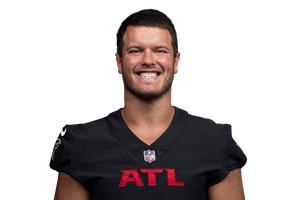
Charlie
Woerner.
 Georgia· 6'5"· 244 lb· 4.78s 40
"A tight end drafted entirely for what he does without the ball, Woerner is a four-year SEC blocker whose value is measured in sealed edges and displaced linebackers rather than in a receiving line."Pre-draft read
An in-line Y who lines up attached, in the wing and in the slot, and whose job on almost every snap is to move someone. He fires off low with a wide base, delivers a compact punch inside the frame and works his hips around to seal the edge on outside zone. He is comfortable pulling across the formation and cutting off backside pursuit, and he finishes through the whistle.
As a receiver he is a functional outlet rather than a threat. He releases cleanly on play-action, catches with strong hands and falls forward, but the route tree is short and he does not separate against coverage. The separating trait is flexibility: he can be used as a fullback, an H-back and a sixth offensive lineman in the same series, which lets an offense change looks without substituting.
Outside-zone running offense with heavy 21 and 12 personnel that asks the tight end to reach and seal the edge and to move as a lead blocker.
Year 1: blocking tight end and core special-teamer in run personnel. Ceiling: the trusted second tight end on a playoff offense built around the run game.
An empty-set spread passing offense that plays one tight end and demands he win from the slot as a receiving mismatch.
His snap count is decided by how much the offensive coordinator wants to run the ball.
Charlie Woerner Best Blocks and Catches at Georgia
The blocking reel that made the case for him: sealed edges, reach blocks and second-level work.
Charlie Woerner Highlights
Compilation of his in-line work and short receiving usage.
Charlie Woerner: Homegrown in Georgia
Team feature on his path from north Georgia to a long NFL blocking-tight-end career.
Woerner is one of the purest role projections in the class. He spent four seasons at Georgia as the blocking tight end in a run-first, pro-style offense and was valued inside the program for exactly that. The evaluation is not about upside at the catch point; it is about whether an NFL offense wants a legitimate in-line blocker who can also line up at fullback and in the slot.
The production line tells you nothing and everything: 34 catches for 376 yards and one touchdown across 42 career games. That is not a receiving prospect. What the tape shows instead is a tight end who consistently handled SEC edge defenders in the run game and did not have to be schemed away from difficult matchups. He was a four-year contributor on a team that sent multiple offensive linemen and backs to the league, and he did his part of that job.
He measured 6-5 and 244 pounds at the combine with short arms at 31 1/8 inches, ran 4.78 and put up 21 bench reps, which confirmed the profile: adequate athlete, functional strength, no vertical threat. Evaluators graded him as a late-round depth tight end who might convert to fullback. San Francisco, running the offense in the league that most values a blocking Y, took him at 190, which was the perfect landing spot for the skill set.
- 01
Legitimate in-line blocker
He sustains against SEC edge defenders from an attached alignment, which is the rarest and most valuable thing on his tape.
- 02
Outside-zone technique
He works his hips around defenders to seal the edge and reaches second-level linebackers on the move without losing his base.
- 03
Alignment versatility
He played attached, in the wing, at fullback and in the slot, so an offense can change its look without changing personnel.
- 04
Strong hands on contact
When the ball comes his way on play-action he secures it cleanly and falls forward rather than losing the catch through contact.
- 05
Four-year program trust
Georgia used him in its heaviest run personnel for four seasons, which is the clearest endorsement of his blocking reliability.
- 01
No receiving production
Thirty-four catches in 42 games gives evaluators nothing to project as a passing-game weapon at any level.
- 02
Short arms
At 31 1/8 inches his length is bottom-of-the-position, which limits how he can re-fit blocks against long defensive ends.
- 03
Predictable route tree
He runs a handful of short concepts, is easily rerouted by physical coverage and does not threaten a seam.
- 04
No yards after catch
He lacks the power to run through tacklers and the hips to run around them, so the reception ends where it is caught.
Relative Athletic Score (Kent Lee Platte) benchmarks combine/pro-day numbers against every measured prospect at the position since 1987. 10.00 is elite; 5.00 is average.
— — — positional median (p50)
- 40 yd
- 4.78sp50
- Vertical
- 34.5inp50
- Broad jump
- 120inp50
- Three-cone
- 7.18sp50
- Shuttle
- 4.46sp50
- Bench
- 21repp50
| Yr | Team | G | Rec | Yds | TD |
|---|---|---|---|---|---|
| 2016 | Georgia | 9 | 5 | 50 | 0 |
| 2017 | Georgia | 9 | 9 | 100 | 0 |
| 2018 | Georgia | 10 | 11 | 148 | 0 |
| 2019 | Georgia | 14 | 9 | 78 | 1 |
| Career | — | 42 | 34 | 376 | 1 |
Four seasons at Georgia, 2016-2019. Season totals sum exactly to the career line of 34 catches for 376 yards and one touchdown in 42 games. Receiving volume understates his role: he was the primary blocking tight end in a run-first offense. Games started by season were not published and are left blank rather than estimated.
A dash means the figure is not published by a source we trust — never a zero we invented.
Big-bodied blocking tight end who lasts a decade on run-heavy personnel with minimal receiving volume.
Same blocking-first role player in a Shanahan offense who carved out years of steady snaps.
Late-round blocking tight end who bounced between rosters without ever locking down a role.
Everything above is the pre-draft evaluation. This section is what actually happened — updated year over year.
San Francisco used him exactly as drafted. He played 14 games as a rookie in 2020 with three catches for 36 yards, then filled the blocking-tight-end role in the Kyle Shanahan offense for three more seasons: 17 games in each of 2021, 2022 and 2023, with five catches in 2021, none in 2022 and three in 2023. Atlanta signed him in 2024 and gave him more snaps as a starter, with a career-best seven catches for 46 yards in 16 games, then 13 starts in 2025 and eight catches for 48 yards. Through his first six seasons he had appeared in 98 regular-season games with 25 starts and six postseason games, with 26 career receptions for 214 yards and no touchdowns.
In hindsight the pick was exactly right and the projection was exactly right. Nobody drafted him expecting receptions, and he has produced almost none; what he produced instead was six-plus seasons of dependable blocking on two teams, including a Super Bowl roster in San Francisco. For pick 190 that is a clear win: sixth-round tight ends usually wash out inside two years. The honest limit is that his lack of receiving ability keeps him tied to run-heavy personnel, so his snap count rises and falls with an offensive coordinator's taste rather than with his own play.