
Brycen
Hopkins.
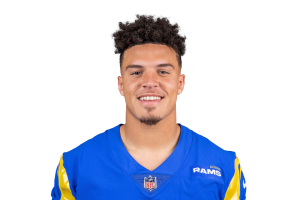
Brycen
Hopkins.
 Purdue· 6'4"· 245 lb· 4.66s 40
"A basketball convert who did not play football until his junior year of high school and left Purdue as the Big Ten tight end of the year — all vertical threat, with no blocking to keep him on the field."Pre-draft read
Hopkins is a 6-5, 245-pound move tight end who plays like a big slot receiver, which fits a former basketball player who did not play organized football until his junior year of high school. He is a smooth, long strider who eats up cushion on seam routes and turns short throws into chunks, averaging better than seventeen yards a catch as a junior.
He is most dangerous flexed away from the formation, isolated on a linebacker or safety, and he adjusts well to the ball with length to win above defenders. Blocking is the hole in the game. He plays with high pads and does not sustain at the point of attack, and there were concentration drops on tape. The signature is vertical stress from the tight end spot.
A spread passing offense that runs twelve personnel as a pass-first grouping and flexes its second tight end into the slot on obvious throwing downs.
Year 1 third tight end and passing-down specialist, with a ceiling as a starting move tight end who catches fifty balls in an offense that never asks him to block.
A run-first, in-line offense that needs its tight ends to seal ends on gap runs and hold up in six-man protection.
Brycen Hopkins - Purdue Boilermakers Tight End - 2019 Highlights
Full reel of the 61-catch senior season that won Big Ten tight end of the year.
B1G Tight End of the Year: Purdue TE Brycen Hopkins
Conference feature on the award-winning fifth-year season.
Purdue TE Brycen Hopkins - 2018 Season Highlights
Junior-year reel showing the 17.1 yards-per-catch vertical work.
Hopkins came to football late — he was a basketball player at Ensworth in Nashville who did not play organized football until his junior year, and Purdue offered him a scholarship after a recruiting coordinator watched him play physical in a pickup basketball game. He redshirted, then grew into the position across four seasons.
The climb was steady. He had ten catches for 183 yards and four touchdowns as the second tight end in 2016, then 25 for 349 the next year, then 34 for 583 and two scores in 2018 while averaging a team-high 17.1 yards a catch, which earned third-team All-Big Ten. His fifth-year season broke everything open: 61 receptions for 830 yards and seven touchdowns, a Mackey Award semifinalist, first-team All-Big Ten and Big Ten tight end of the year. He had ten catches for 140 yards against Maryland, eight for 127 and two scores at Wisconsin — the first Purdue tight end since at least 1997 with eight catches, a hundred yards and two touchdowns in a game — and eight for 142 with two more against Indiana.
The evaluation liked the movement and worried about everything else. He was a receiving specialist who could not block, with drops on tape and a late football background. That is a Day 3 tight end. The Rams took him at 136.
- 01
Vertical seam threat
A long strider who eats cushion down the middle and averaged 17.1 yards a catch as a junior, a team high on a Big Ten offense.
- 02
Late-season surge
Sixteen catches for 269 yards and four touchdowns over his final two college games, both against Big Ten opponents.
- 03
Historic production
Sixty-one catches for 830 yards and seven scores as a fifth-year senior, the best Purdue tight end season since Dustin Keller in 2007.
- 04
Flex alignment value
Purdue isolated him away from the formation against linebackers and safeties, and he won those matchups consistently.
- 05
Athletic background
A basketball player by training with the body control and ball-tracking that shows up on contested throws downfield.
- 01
Cannot block in line
Plays with high pads and does not sustain at the point, which keeps him off the field on early downs in most NFL offenses.
- 02
Concentration drops
Put the ball on the ground on routine catches, an issue that followed him across multiple seasons at Purdue.
- 03
Late to the sport
Did not play organized football until his junior year of high school, so the route detail and physical technique lagged.
- 04
One-dimensional projection
A pure receiving tight end without special teams value, which is a narrow role to hold on a fifty-three man roster.
Relative Athletic Score (Kent Lee Platte) benchmarks combine/pro-day numbers against every measured prospect at the position since 1987. 10.00 is elite; 5.00 is average.
— — — positional median (p50)
- 40 yd
- 4.66sp50
- Vertical
- 33.5inp50
- Broad jump
- 116inp50
- Three-cone
- 7.25sp50
- Shuttle
- 4.28sp50
- Bench
- 21repp50
| Yr | Team | G | Rec | Yds | TD |
|---|---|---|---|---|---|
| 2016 | Purdue | — | 10 | 183 | 4 |
| 2017 | Purdue | — | 25 | 349 | 3 |
| 2018 | Purdue | 13 | 34 | 583 | 2 |
| 2019 | Purdue | — | 61 | 830 | 7 |
| Career | — | 13 | 130 | 1945 | 16 |
The 2018 line comes from the Purdue athletics bio, the 2016 and 2017 lines from his Wikipedia college summary, and the 2019 total of 61 catches for 830 yards and seven touchdowns from the RotoWire season wrap, consistent with the Purdue release crediting him with 45 catches for 561 yards through ten games. Career totals are the sum of the four seasons. Games and starts outside 2018 were not published in the sources checked and are left empty. He redshirted in 2015.
A dash means the figure is not published by a source we trust — never a zero we invented.
A tight end who hangs around a roster for years with modest production and no defined role.
The ceiling: a flex tight end who wins purely as a receiver and becomes a genuine target-earner when the offense is built for him.
A productive college receiving tight end who cannot block and is out of the league inside four seasons.
Everything above is the pre-draft evaluation. This section is what actually happened — updated year over year.
Hopkins never found a role in Los Angeles. He was inactive for most of his rookie year and played five games without a catch, then five more games in 2021 with a single reception, though he earned a Super Bowl LVI ring as part of that roster. He got his most playing time in 2022 with fourteen games and seven catches for 109 yards, then fifteen games in 2023 with five catches for 78 yards. He never scored an NFL touchdown.
Across four seasons he appeared in 39 games with thirteen receptions for 196 yards. The 15.1 yards-per-catch average is the one number that matches the college scouting report — when he did get the ball, it went somewhere. Everything else is the blocking. In hindsight the report was correct and the pick was reasonable at 136: a receiving tight end who cannot block needs volume to justify snaps, and a Rams offense built around Cooper Kupp, an elite receiver room and heavy eleven personnel never needed a second pass-catching tight end. The talent was real and the fit never was.