Antonio
Gandy-Golden.
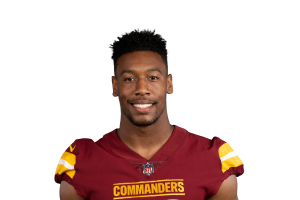
Antonio
Gandy-Golden.
 Liberty· 6'4"· 223 lb· 4.60s 40
"A 6-4 boundary receiver with back-to-back 1,000-yard seasons and a 245-yard game in Liberty's first FBS years, whose catch radius was NFL-grade and whose separation never was."Pre-draft read
Gandy-Golden is a 6-4, 223-pound perimeter receiver built around contested-catch volume. He plays with strong hands away from his frame, adjusts late to the football, and wins the fifty-fifty ball at the boundary and in the back corner of the end zone as well as anyone in the class.
He is a build-up strider who eats cushion on vertical routes and finishes with plus body control on back-shoulder throws, which is where most of his 1,396-yard senior season came from. He blocks willingly on the edge. The concerns are quickness and competition: a 4.60 forty and 7.33 three-cone match a receiver who builds speed rather than separating, on a narrow route tree. The signature is catch radius.
A vertical passing offense that isolates an X receiver on the boundary and throws him back-shoulder and fade balls rather than asking him to win underneath.
Year 1 fourth receiver and red-zone specialist, with a ceiling as a starting X who produces 700 yards and eight touchdowns on limited targets.
A timing-based West Coast offense built on option routes and quick separation underneath.
2020 NFL Draft Film Room: Antonio Gandy-Golden (WR Liberty)
Pre-draft breakdown of the catch radius, release limitations and route usage.
Antonio Gandy-Golden (Liberty WR #11) vs. Syracuse 2019
Full-game cut-up against a Power Five defense: six catches for 119 yards.
Antonio Gandy-Golden (Liberty WR #11) vs. UMass (2018)
The nine-catch, 205-yard, two-touchdown game from his first 1,000-yard FBS season.
Gandy-Golden arrived at Liberty out of Paulding County High in Dallas, Georgia and became the most productive receiver in the program's modern history during its transition from FCS to FBS. He earned first-team All-Big South and second-team All-State honors as a sophomore in 2017 across ten games with eight starts.
The big years followed. As a junior in 2018 he started all eleven games for 1,037 yards and ten touchdowns, becoming just the second player in program history with back-to-back 1,000-yard seasons, posting four 100-yard games including two over 200, and setting the school single-game record with 245 yards on eleven catches at New Mexico. He was Phil Steele first-team All-Independent. His senior year was better still: 79 catches for 1,396 yards and ten scores in thirteen games, fourth in the country in receiving yards and fifth in yards per game, with 205 at UMass, 181 against Hampton and 174 against Buffalo. He also caught six for 119 against Syracuse and three against Auburn, the two Power Five tests on the schedule.
The board liked the size and production and hesitated over the athletic testing and the competition, since Liberty was a brand-new FBS program with a soft schedule. He went to the Senior Bowl to answer it. Washington took him at 142.
- 01
Contested-catch dominance
Wins fifty-fifty balls at the boundary and in the end zone with strong hands and late adjustment at 6-4, 223 pounds.
- 02
Production at scale
Back-to-back 1,000-yard seasons, the second in program history, capped by 1,396 yards to rank fourth nationally as a senior.
- 03
Big-game volume
Games of 245, 205, 181 and 174 yards show he can carry an offense rather than just finish drives that others build.
- 04
Body control
Tracks the deep ball over either shoulder and contorts on back-shoulder throws without losing his feet along the sideline.
- 05
Willing blocker
Engages on the perimeter in the run game, which is not a given for a big receiver used mostly as a downfield target.
- 01
Short-area quickness
A 4.60 forty and a 7.33 three-cone confirm the tape: he builds speed instead of separating out of breaks.
- 02
Level of competition
Liberty's schedule during its FBS transition rarely gave him a Power Five cornerback, and his two such games were quiet.
- 03
Limited route tree
Used mostly on go routes, comebacks and fades, so the full NFL route menu is projection rather than evidence.
- 04
Separation at the line
Can be slowed by physical press corners who take away his release and make him work back to the football.
Relative Athletic Score (Kent Lee Platte) benchmarks combine/pro-day numbers against every measured prospect at the position since 1987. 10.00 is elite; 5.00 is average.
— — — positional median (p50)
- 40 yd
- 4.60sp50
- Vertical
- 36inp50
- Broad jump
- 127inp50
- Three-cone
- 7.33sp50
- Shuttle
- 4.55sp50
- Bench
- 22repp50
| Yr | Team | G | Rec | Yds | TD |
|---|---|---|---|---|---|
| 2017 | Liberty | 10 | 0 | 0 | 0 |
| 2018 | Liberty | 11 | 71 | 1037 | 10 |
| 2019 | Liberty | 13 | 79 | 1396 | 10 |
| Career | — | 34 | 0 | 0 | 0 |
The 2018 and 2019 lines are confirmed by both the Liberty athletics bio and the Tankathon draft profile (71-1,037-10 and 79-1,396-10). The 2017 sophomore season is listed by Liberty as ten games with eight starts and first-team All-Big South honors, but no receiving line was published in the sources checked, so it is left empty. StatMuse lists a four-year career of 164 receptions for 2,672 yards and 22 touchdowns; that figure cannot be reconciled with the itemized seasons available, so no career total is entered rather than publish a number that does not sum.
A dash means the figure is not published by a source we trust — never a zero we invented.
A contested-catch specialist whose lack of separation keeps him a secondary target on short NFL stays.
The ceiling: a big-bodied boundary receiver from a smaller program who becomes a legitimate 1,000-yard X.
A small-program producer whose athletic limits leave him with almost no NFL production before release.
Everything above is the pre-draft evaluation. This section is what actually happened — updated year over year.
It never came together in Washington. He was inactive for much of his rookie year, played six games in 2020 with two starts and finished with one catch for three yards plus a 22-yard end-around run. The team tried to find a use for him in 2021, when he appeared in four games and worked at tight end during training camp in an attempt to turn the size into a matchup role, and he was released in 2022 without adding a catch.
His entire NFL production is one reception for three yards across ten games. The gap between the college tape and the league came down to exactly the thing the scouting reports flagged: he could not separate against NFL press coverage, and a big receiver who cannot get off the line has to win every ball in traffic to stay employed, which is a brutal margin. This is not a story of a wasted talent so much as a Day 3 bet on size and volume against a soft schedule, made with full knowledge of the risk, that came back empty.